

In A Nutshell
Russia’s Lake Karachay was used in the 1950s as a dumping site for radioactive waste. It became known as the most polluted place on the planet, with enough radioactivity on its shores to kill a person in less than an hour. Russia finished burying the lake under concrete and rock in 2016, but the waste is still sitting right there under the surface. At its height, it was putting more than 200,000 times the normal amount of radioactivity into the area due to poor waste disposal practices.
The Whole Bushel

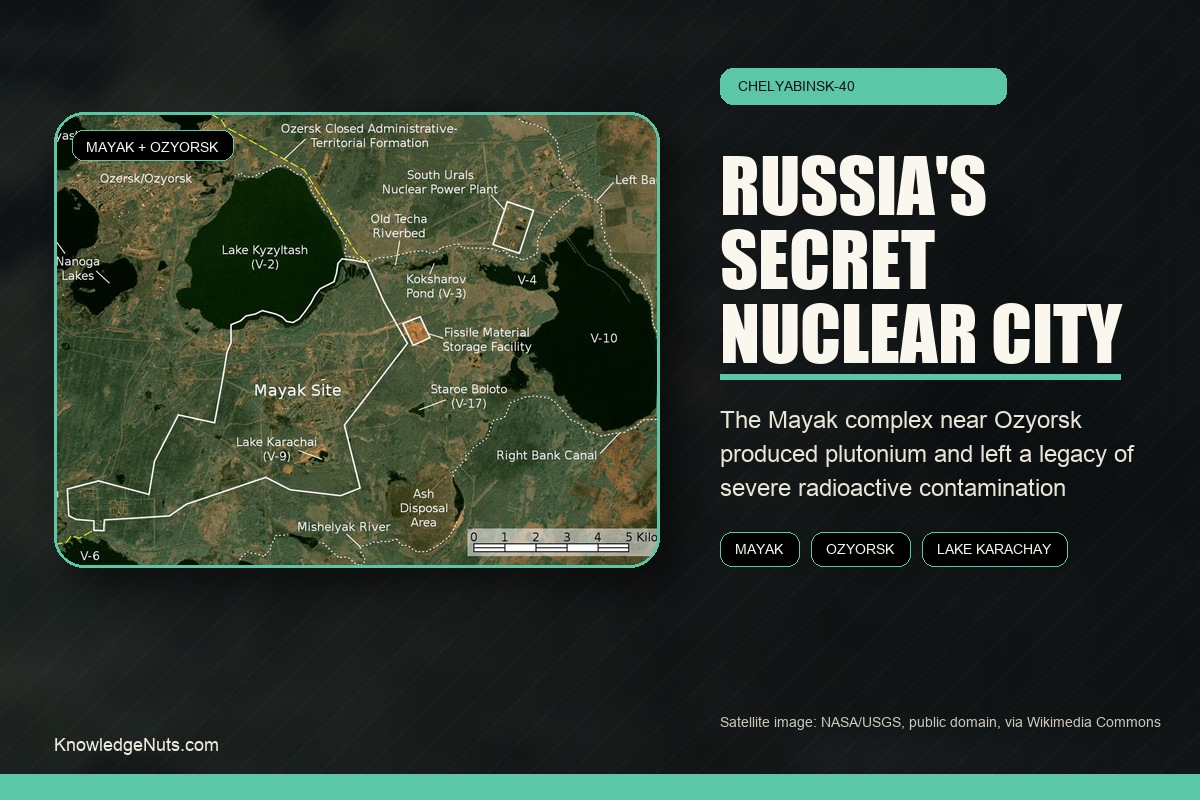
Deep in the Ural Mountains of Russia lies a beautiful, picturesque body of water called Lake Karachay. But don’t get too close—it’s a silent killer, and for decades it emitted lethal doses of radiation. In the mid 1940s, the Soviet Union built a secret city in the Southern Urals called Chelyabinsk-40. The purpose: to manufacture nuclear weapons from uranium-238. By 1948, the first reactor was up and running, and the Chelyabinsk-40 facility (later renamed Chelyabinsk-65—today it’s the Mayak plant in the closed city of Ozyorsk) was working at full steam, converting uranium into plutonium and shipping it off to the bomb builders.
But there was one problem—when they built the facility, all the planning and resources went into creating the plutonium, but not getting rid of the waste. So they did what most people have done at some point—they dumped it in the closest river. Specifically, the Techa River, which provided water for about 39 towns and villages downstream from the plutonium plant.
After three years of unwittingly poisoning their own populace, the Soviet Union sent researchers out to make sure the waste wasn’t getting out of control. Here’s what they found: Normal background in the area amounts to roughly .21 Röntgens each year. The Techa River was emitting 5 Röntgens on an hourly basis.
So they dammed up the river, relocated tens of thousands of villagers, and, having learned from past mistakes, found a new place to dump their nuclear waste cocktail: Lake Karachay. For somewhere between 30 to 40 more years (the Soviet Union didn’t even acknowledge its existence until 1990), Lake Karachay was the primary waste reservoir for the Chelyabinsk plant. The reasoning was that Lake Karachay didn’t have any surface outlets—one river went in, no rivers came out—so there was no way for the radioactive waste to escape. However, later testing revealed that the lake’s waters were definitely seeping out through the groundwater into the surrounding Asanov swamp.
Dumping wasn’t even the site’s worst moment. In September 1957, a tank of concentrated waste at the plant exploded and scattered radioactive material across more than 52,000 square kilometers (20,000 sq mi) of the surrounding countryside. That event, remembered as the Kyshtym disaster, forced around 10,000 people out of their villages, and it stood as the worst nuclear accident in history until Chernobyl.
To make matters worse, a 1967 drought dried up part of the lake, leaving a wide shoreline covered in radioactive dust. When the winds came, that nuclear dust cloud went airborne and drifted across 2,300 square kilometers (900 sq mi), containing half a million people. Instances of leukemia in the area rose a whopping 41 percent in just a few years.
In 1990, measurements taken near the spot where the waste went in showed the shores of Lake Karachay giving off 600 Röntgens per hour, and that’s about as much radiation as it takes to guarantee a slow death. But that wasn’t all anyone had to be worried about: The entire area was so unstable that if a single dam broke, the Techa River and all its radiation could pour through the Asanov swamp, into the Ob’ River, and out into the Arctic Sea, where currents would carry 120 million Curies of radioactivity into the Atlantic.
Russia eventually decided the only fix was to make the lake disappear. Crews had been dropping hollow concrete blocks into the water since the late 1970s, and by November 2015 the plan to seal off the lake reached its last stretch of open water. The final layer of rock and soil went down in December 2016, turning the lake into a dry nuclear waste storage site sitting just below ground. The Mayak plant next door kept working, and it kept drawing suspicion. After a cloud of ruthenium-106 drifted across Europe in late 2017, a 2019 study traced the most likely source to Mayak—a conclusion Russian officials reject, noting that no incident was ever reported at the plant. The lake is gone from the map, but nobody calls the area clean.
Show Me The Proof
Russia’s Plutonium
Weapons of Mass Destruction: Chelyabinsk-65 / Ozersk
Concentration factors in reservoir 11 and Asanov Swamp
