

In A Nutshell
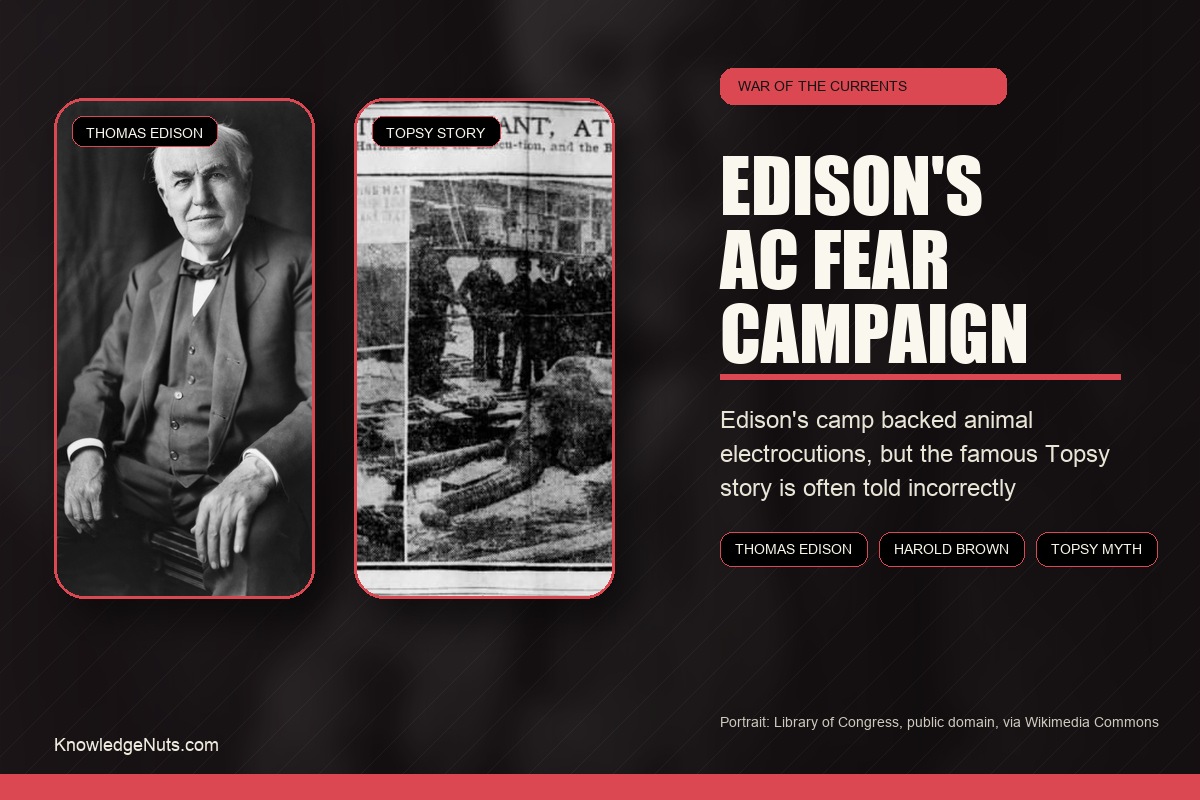
In an effort to showcase the dangers of alternating current (AC) and discredit George Westinghouse and Nikola Tesla, Thomas Edison’s camp held public demonstrations that electrocuted animals such as dogs, cats, and horses in front of a crowd. The famous claim that Edison also fried an elephant is a myth, though. Topsy the elephant was put to death by other people in 1903, years after the fight was over.
The Whole Bushel
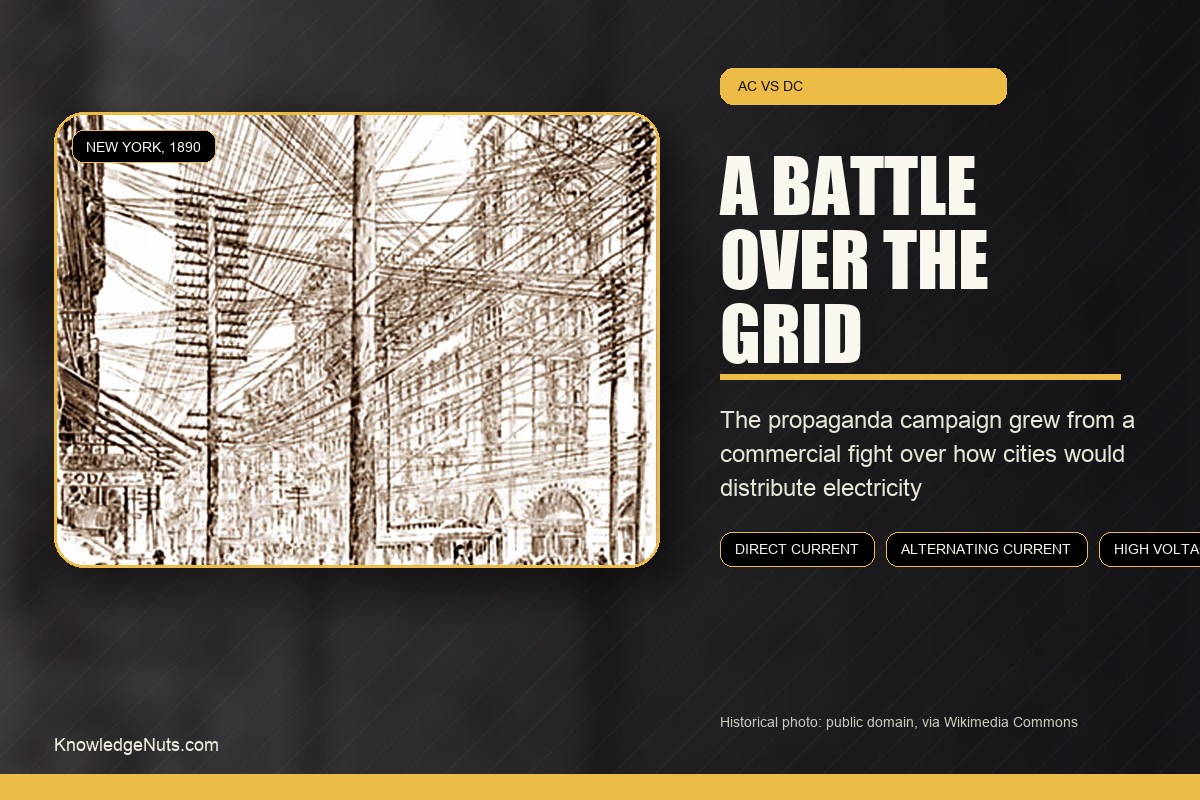
The bitter rivalry between Thomas Edison and Nikola Tesla is now the stuff of legend, and it all came to a head during the War of the Currents. On the one side, Edison felt that direct current (DC) was the wave of the future. On the other side, Tesla believed that alternating current (AC) was more efficient for transmitting power over longer distances. Edison launched a massive public campaign to discredit AC, while Tesla partnered with financial mogul George Westinghouse in an attempt to convince power companies to switch over to AC using Tesla’s patented AC induction motor.
By this point, the two inventors were old acquaintances, although there was nothing friendly about their relationship. When Tesla moved from France to New York in 1884, the penniless immigrant got a job at the Edison Machine Works as an engineer. Within a year, he was already solving technical problems for the company, and Edison approached him with the task of redesigning the DC generators for the entire company. He famously offered Tesla $50,000 if he could make the generators more efficient, and a few months later, Tesla came back with an improved design. But when he asked for his money, Edison laughed and said, “When you become a full-fledged American, you will appreciate an American joke.” Since Tesla had redesigned the generators while working for Edison, he had no claim to the patent, and essentially got nothing out of the agreement (although Edison offered him a raise of $10 per week. Tesla resigned on the spot).
A few years later, Tesla built his AC induction motor, and the War of the Currents began. Edison’s main campaign strategy was to prove that AC, which used much higher voltages than DC, was simply too dangerous to use in homes. And to prove that, his side went to ruthless extremes. An electrician named Harold Brown, backed by Edison’s lab, staged demonstrations executing stray dogs and cats, and later cows and horses. One of the first took place in 1888, with the public electrocution of a large dog. Brown first sent 1,000 volts of DC through the animal to prove it would be—if not unharmed—still alive. Then he hooked the dog up to 300 volts of AC and smoked the pup into oblivion.
The one animal everyone remembers wasn’t Edison’s doing at all. In 1903, a circus elephant named Topsy was put to death with 6,600 volts of AC at Coney Island while about 1,500 people stood by and watched. One of Edison’s film crews recorded it for a short released as Electrocuting an Elephant. That title, with Edison’s name attached to the film, is why the story stuck to him. By then the War of the Currents had been over for a decade, and Edison was never there. Topsy was condemned by the owners of Luna Park after she killed a man who had tormented her. When their plan to hang her drew an objection from the SPCA, they used a mix of poison, strangulation, and electrocution instead. The 6,600 volts came from a local utility that carried the Edison name under license, not from Edison himself.
The real test came in 1890 though, and it was no ordinary animal: The victim was a convicted murderer named William Kemmler. Edison campaigned for the opportunity to create a “more humane” method of capital punishment and, still in the midst of the War of the Currents, he opted to create the electric chair with AC. After all, what better way to prove the dangers of AC than by killing a man with it? And he couldn’t have asked for a more visceral demonstration: The first charge burned through Kemmler’s insides for a whole 17 seconds, after which he was still gasping for breath. The second charge lasted four minutes, and Kemmler burst into flame before finally dying.
Show Me The Proof
Time Magazine: Shock Treatment
Wired: Edison Fries an Elephant to Prove His Point
Empires of Light: Edison, Tesla, Westinghouse, and the Race to Electrify the World, Jill Jonnes
Rutgers Thomas A. Edison Papers: Myth Buster—Topsy the Elephant
