

In A Nutshell
Calling something a graphic novel isn’t just a fancy way of saying “comic book.” There’s a very clear difference between the two. Graphic novels are much longer and tend to be much more complex. While a comic book will tell a story over many issues, graphic novels more often have their storylines wrapped up in only one or two books.
The Whole Bushel

Accuse someone who’s reading a graphic novel of being into comic books, and you’re likely to get a dirty look at the very least (or a lecture at the very slightly worse). They might look the same at a glance, but they’re actually very different types of story medium.
Both comic books and graphic novels use a combination of illustrations and words to tell a story. That story can be anything, whether it’s fiction or non-fiction, the tale of a superhero or of a zombie apocalypse. The difference isn’t so much in the content, but in the presentation.
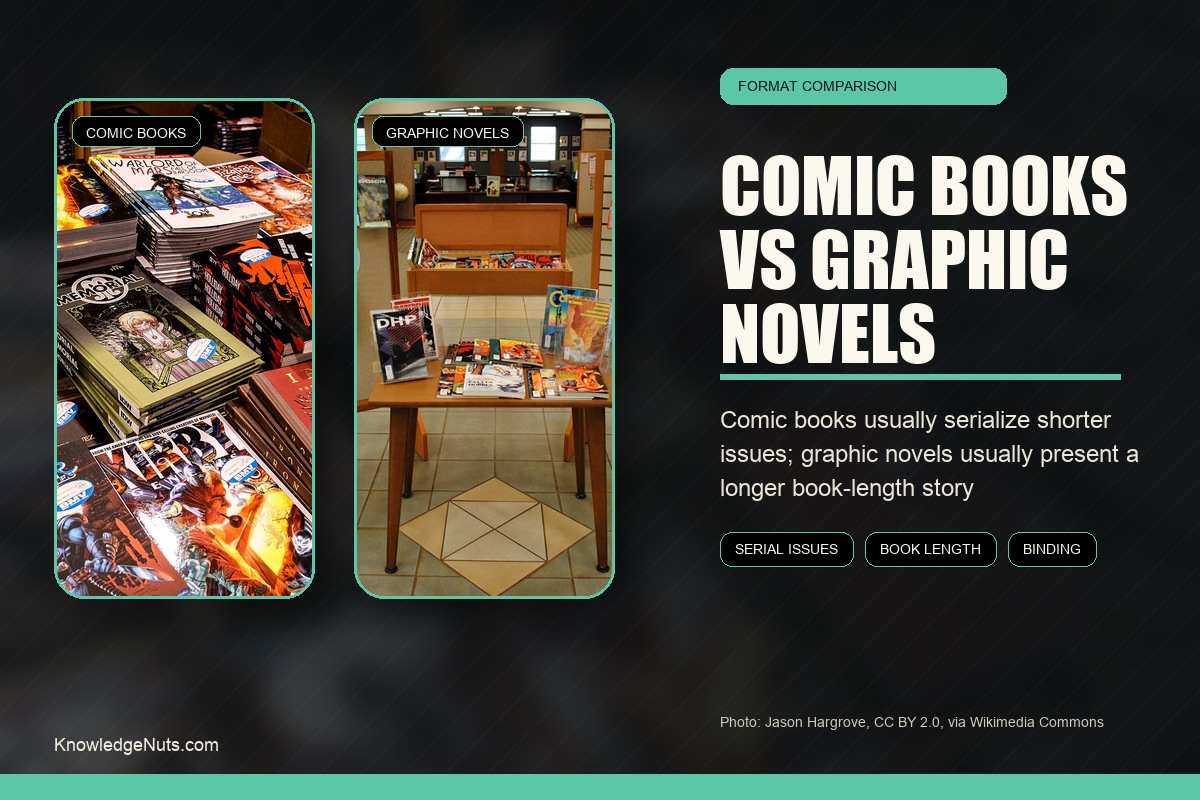
Comic books are serialized stories; most are relatively short, and tell the story of the book’s heroes and heroines over a long period of time. There are usually many, many issues of a successful comic book, and the stories unfold over months and sometimes years. A typical single issue is a thin, stapled thing, usually a few dozen pages with ads mixed in.
Graphic novels are longer works that tell a single story from the beginning to the end. They’re bound like regular books, with glued spines and sturdier paper instead of staples. (Sometimes, successful comic books will be collected and packaged in a graphic novel format.) The industry calls those collections trade paperbacks, and a good chunk of what sits on the graphic novel shelf at any bookstore started out as monthly issues. Because stories don’t have to be broken up over countless issues, plots can often be more complex and more detailed, as readers don’t have to remember details for anywhere from months to years while reading. Manga is a bit of its own thing. It’s the blanket name for Japanese comics, and most of it starts out serialized in thick anthology magazines before being collected into book volumes. The pages are read from top to bottom and right to left since that is how the Japanese language is traditionally read.
Graphic novels actually pre-date comic books. It’s thought that the first graphic novel ever published was the 1783 adaptation of Gottfried August Burger’s Lenardo und Blandine. Illustrated by Joseph Franz von Goez, the 160-frame work tells the story of two ill-fated lovers. Blandine, the daughter of the king, falls in love with and marries her father’s faithful courtier, Lenardo. Her father promises her to someone else, kills Lenardo, and tells his daughter of her husband’s death by sending her three messengers bearing a ring, a letter, and an urn containing her husband’s heart. She does, of course, go mad and die of grief.
Although individual comics have been around for centuries, comic books are a relative newcomer to the literary world. Single-panel comics have been published in papers and broadsheets since the mid-1700s, and comic strips became popular around the end of the 19th century. Comic books as we know them today, though, are generally thought to have found their origin with Funnies on Parade in 1933 and Action Comics #1 (the first appearance of Superman) in 1938.
Comic books cornered the market for decades, until a resurgence in the popularity of graphic novels. In the 1980s and 1990s, British authors like Alan Moore and Neil Gaiman brought graphic novels back into the mainstream market. The term itself is older than that. A fan historian named Richard Kyle coined it in 1964, and Will Eisner put it on the cover of his book A Contract with God in 1978. The big turning point came in 1986 and 1987, when Maus, The Dark Knight Returns, and Watchmen all became hits in collected editions. Maus went on to win a special Pulitzer Prize in 1992, a first for comics. Graphic novels have enjoyed a period of underground popularity as artists and writers tried to make the separation between mediums clear. Graphic novels got a reputation as being gritty, explicit, and for mature audiences, while comic books were relegated to more mainstream popularity. Ironically, comic books have long carried their own stigma of being a childish, immature, guilty pleasure at best.
Fortunately, thanks to big-screen adaptations of both graphic novels and comic books, some of that stigma is being stripped away after decades.
Even so, don’t expect everyone to agree on the label. Alan Moore called “graphic novel” a marketing term he “never had any sympathy with,” one that “just came to mean ‘expensive comic book.’” Plenty of cartoonists side with him and simply call it all comics. Librarians, publishers, and bookstores find the label too useful to drop. So if you do get that dirty look, take comfort. The professionals are still arguing about it too.
Show Me The Proof
Heritage Auction Galleries: A Brief History of Comic Books
Lenardo und Blandine, illustrated by Joseph Franz von Goez
Get Graphic: The World In Words and Pictures
Graphic Novels: History and Basics
Wikipedia: Graphic Novel
Wikipedia: Manga
