

In A Nutshell
According to the first fully constructed and explained theory that involved the Earth revolving around something else in a regular orbit, our planet was part of a solar system that also included a mysterious Counter-Earth that existed opposite to us and would never be seen. There was also a moon that was inhabited by massive, beautiful lunar animals, and a sun that reflected the light from a Central Fire, giving us heat and light without burning us in the blinding rays of the fire Prometheus stole from the gods.
The Whole Bushel


For as long as mankind has had the time to look up into the night sky, we’ve been trying to figure out just what’s up there. There have been all kinds of theories about how our solar system, our galaxy and the universe beyond is constructed, but an often-overlooked and rather interesting theory came from the great Pythagorean philosopher Philolaus. In a brilliant mix of astronomy, mathematics, and mythology, the picture the Pythagoreans paint is a breathtaking one.
According to Philolaus, our solar system is made up of 10 celestial bodies. The number wasn’t a coincidence, either, as the number 10 was thought to be special, even godly, representing all that was mystical and divine that we didn’t quite understand. (Numbers in the Pythagorean school of mathematics and philosophy had a real-world association. The number one was a single point, two represented a line, three made a surface, and on up to the sacred 10.)
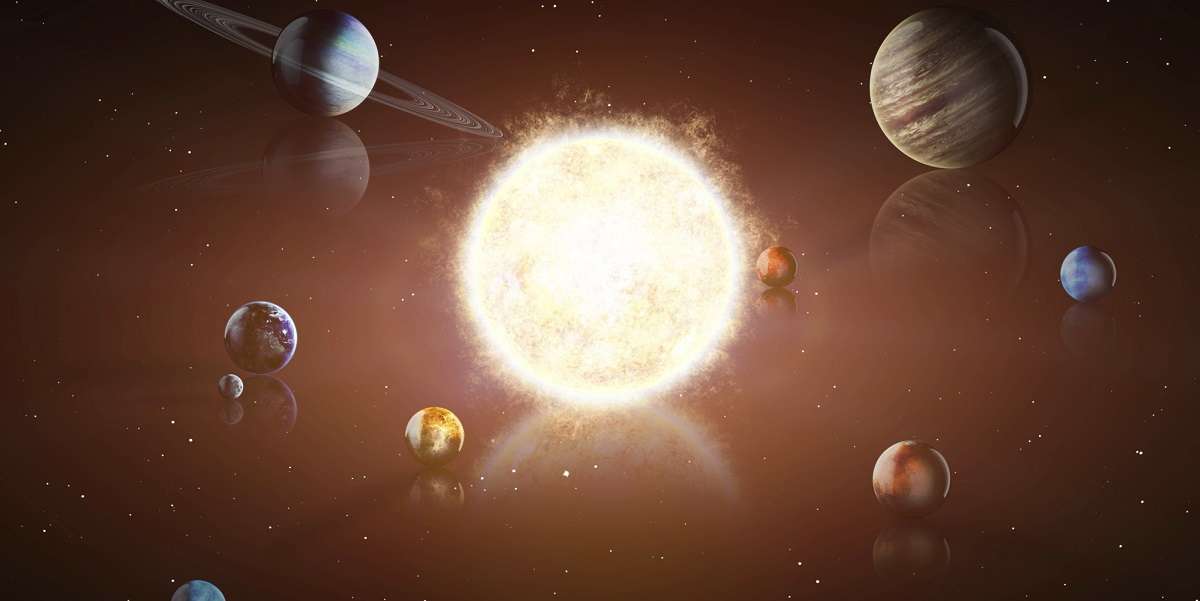
It was the Pythagoreans that said the Earth was a sphere, and so were all the other bodies that were floating around with us—five planets, the sun, the moon and our twin planets. And, importantly, they weren’t just floating, they were all moving around a central point. They may have had the details wrong, but it was still the first fully developed model of the solar system in which planets—and other bodies—rotated around each other in a circular pattern.
Since everything in the Pythagorean belief system was traced back to music and numbers, it made sense that there needed to be 10 bodies, and that everything had to be balanced.
Balancing Earth was Counter-Earth, a mysterious planet that we would never be able to see or otherwise detect, as it was always on the opposite side of the center of the solar system, which was occupied not by the Sun but by a body called the Central Fire. The Central Fire, also called Hestia and equated with the fire that Prometheus stole from the gods to give mankind, was thought to be the hearth of the heavens. Hestia existed as a balance to all, but it, too, was impossible to see from the Greek’s place on the surface of Earth.
That’s because of the way the planets rotated. While Philolaus did notably get it right that the Earth moved around the solar system’s central point in an elliptical pattern, he thought that our planet would rotate—balanced on the other side by the unseen Counter-Earth—to always keep us facing away from the potentially deadly Central Fire. We would never see the Central Fire, either; instead of getting light and heat from Hestia directly, he put forth that it was instead reflected off the Sun, which also orbited Hestia, and then reached us.
Philolaus got an interesting mix of things very right and very wrong. He was spot-on about the length of time the Earth takes to make a complete obit of the system’s central body, projecting a year was 364.5 days. But he also believed that the moon was something of a twin to Earth as well, a lunar reflection of what was found around us. He said that there was lush vegetation and animals that roamed the moon’s surface, all bigger and more beautiful than those we saw every day. Also, in an oddly specific detail, he added that lunar animals excreted no waste.
Show Me The Proof
Stanford Encyclopedia of Philosophy: Philolaus
Early Heliocentric Systems: The Pythagoreans


