

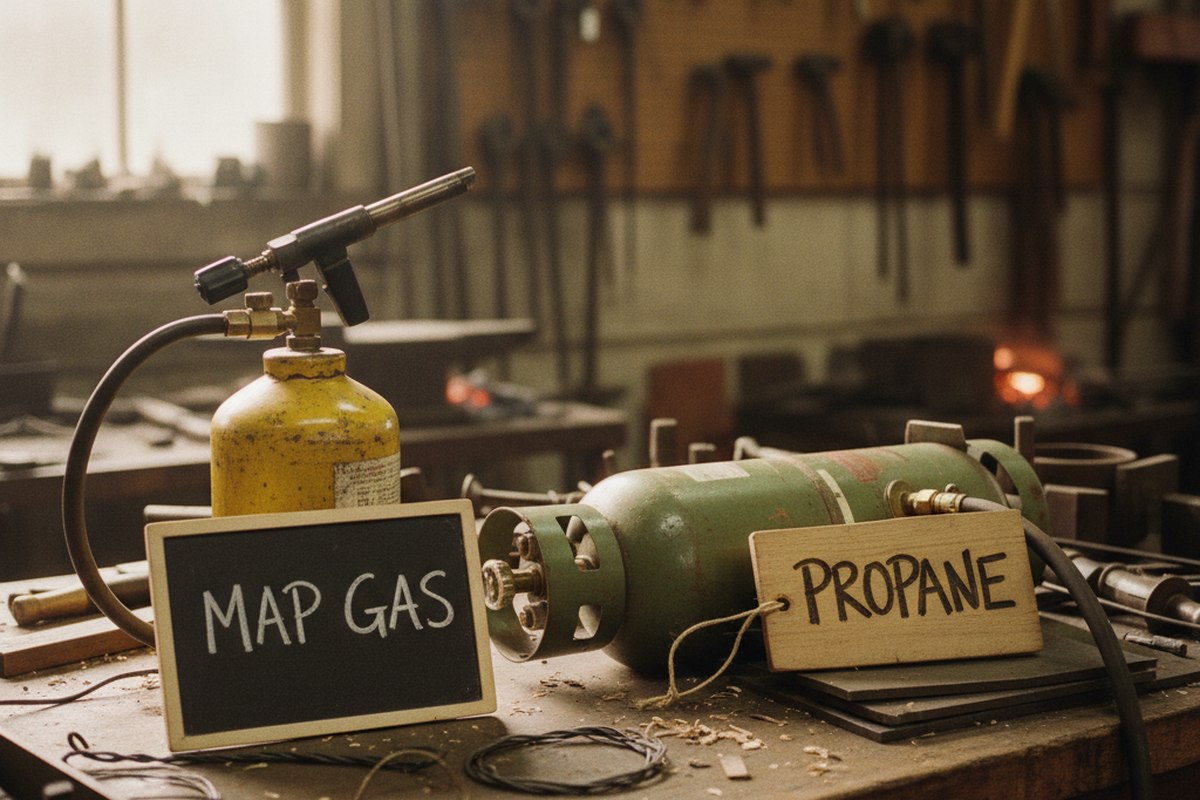
MAP gas (originally Methylacetylene-Propadiene, often labeled “MAPP”) and propane are two common torch fuels. They are used for plumbing work and other heat applications such as brazing or solder joints. The two look similar in handheld torch cylinders but differ in flame temperature, fuel composition, and ideal use cases.
Original MAPP gas (a mixture of methylacetylene and propadiene) was discontinued in the US in 2008 by its main producer. Modern “MAP-Pro” or “MAP” gas sold today is primarily propylene, with similar performance characteristics. The yellow-cylinder torch fuel sold at hardware stores is now usually MAP-Pro.
Propane (C3H8) is a hydrocarbon gas used widely as a torch fuel, BBQ grill fuel, and home heating fuel. It’s cheaper than MAP gas and burns at a lower temperature, but is more than adequate for most household applications.
Original MAPP gas burned at about 5,300°F in pure oxygen and about 3,720°F in air; propane burns at about 3,600°F in air. In air, the gap is modest, but it still matters when a job needs faster heating.
Here is how MAP-Pro and propane differ in composition, temperature, cost, safety, and use.
What MAP gas (MAP-Pro) is
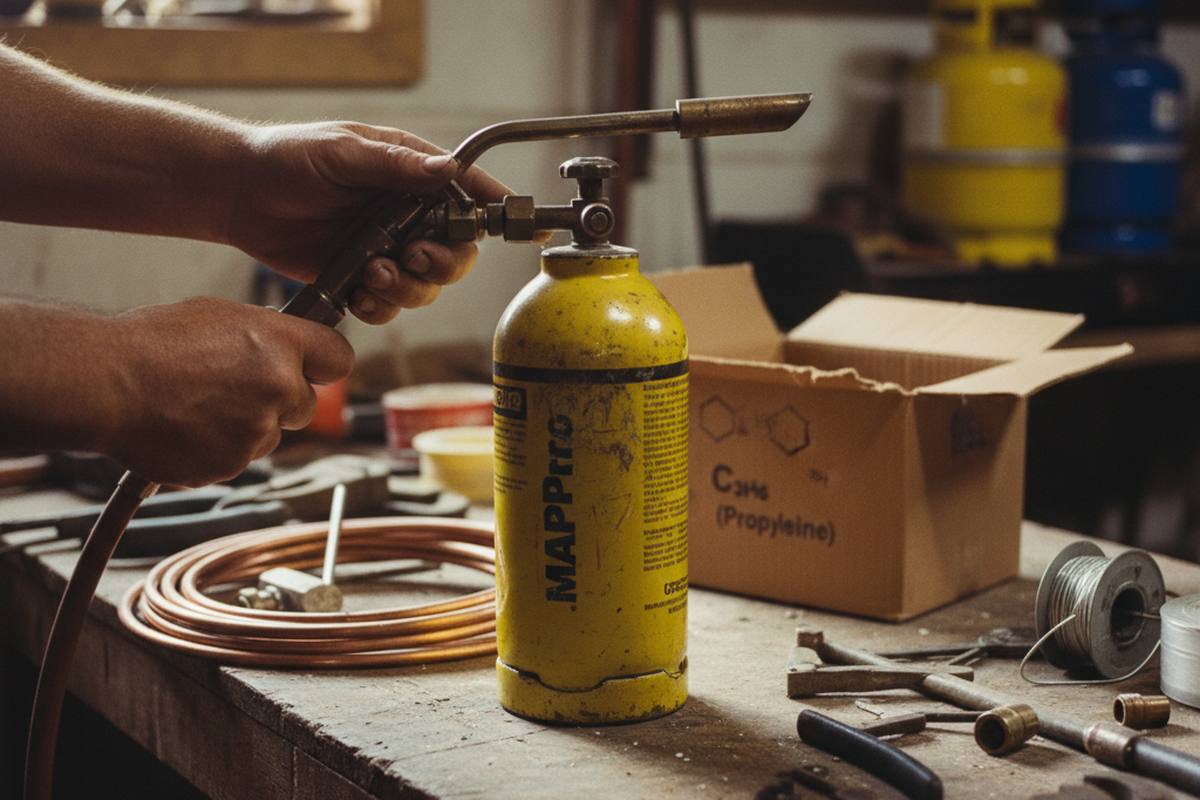
MAP gas is the name many people still use for yellow-cylinder torch fuel sold for plumbing, brazing, and soldering. The current product is more accurately MAP-Pro, and it is mostly propylene-based.
Defining traits of MAP-Pro:
- Composition: primarily propylene (C3H6)
- Cylinder color: yellow (industry convention)
- Flame temperature in air: ~3,720°F (2,050°C)
- Flame temperature in oxygen: ~5,200°F (2,870°C)
- Density: heavier than air
- Price: ~$10-15 per 14-16 oz cylinder
- Burns hotter than propane in air
- Common uses: plumbing solder, brazing, light brazing, torch work
History:
- Original “MAPP” gas (true methylacetylene-propadiene) was developed by Dow Chemical in the 1960s
- Used widely in welding and brazing through the 1990s and 2000s
- US production ended (last plant closed in the late 2000s)
- “MAP-Pro” replaced it (mostly propylene with some propane)
- Industry uses MAP gas and MAP-Pro interchangeably in casual conversation
Common applications:
- Brazing copper pipe joints (plumbing)
- Soldering with silver solder
- Soft soldering of larger pipes (3/4 inch and larger)
- Hot work on metals up to about 1/4 inch thick
- Heating frozen pipes
- Loosening rusted bolts
MAP-Pro is often preferred for larger pipe soldering because it heats faster and reaches working temperature sooner than propane.
What propane is
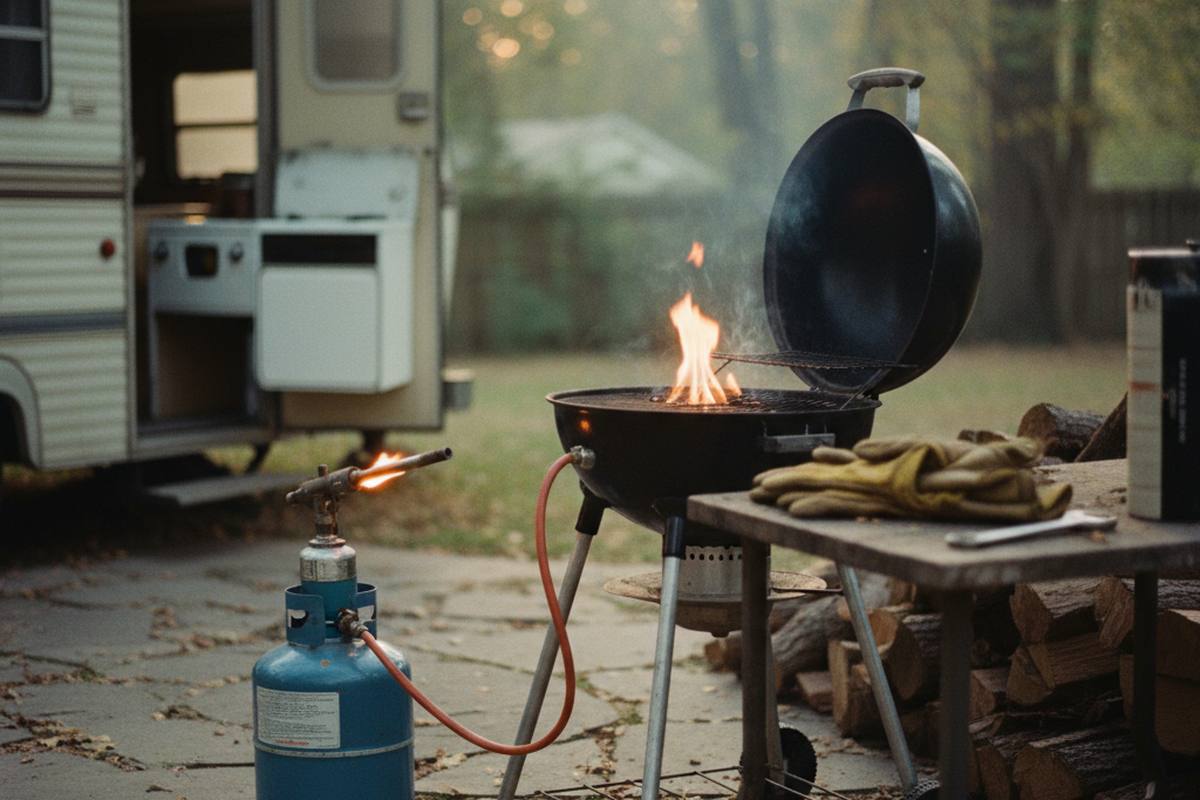
Propane (C3H8) is a saturated hydrocarbon gas widely used as a fuel. It’s the same gas used in home heating, BBQ grills, RV stoves, and torches.
Defining traits of propane:
- Chemical formula: C3H8
- Cylinder color: blue or various (industry convention)
- Flame temperature in air: ~3,600°F (1,980°C)
- Flame temperature in oxygen: ~5,100°F (2,820°C)
- Density: heavier than air
- Price: ~$5-10 per 14-16 oz cylinder
- Cheaper than MAP gas
- Wide range of uses
Common applications:
- Home heating
- BBQ grills
- Camping stoves
- RV appliances
- General-purpose torch work
- Soft soldering of small pipes
- Heating and warming
Propane is usually the cheaper choice for casual torch work and general household jobs. It burns a little cooler, but it is hot enough for many home plumbing tasks when speed is not the main concern.
Side-by-side comparison
The clearest way to see the differences is feature by feature:
| Feature | MAP-Pro (MAP gas) | Propane |
|---|---|---|
| Main composition | Propylene (C3H6) | Propane (C3H8) |
| Flame temp in air | ~3,720°F | ~3,600°F |
| Flame temp in oxygen | ~5,200°F | ~5,100°F |
| Cylinder color | Yellow | Blue/various |
| Cylinder price | $10-15 | $5-10 |
| Heating speed | Faster | Slower |
| Soldering pipe size | Up to 3-4 inch | Up to 1-2 inch |
| Brazing capability | Yes (with care) | Limited |
| BBQ/grill use | No | Yes |
| Home heating | No | Yes |
| Camping use | Less common | Common |
| Common cylinder size | 14-16 oz handheld | 14-16 oz handheld; 20 lb tank |
A quick shorthand is this: MAP-Pro is hotter, faster, and more expensive; propane is cooler, slower, and cheaper. For many home plumbing jobs, both can work.
Original MAPP vs current MAP-Pro
True original MAPP:
- Methylacetylene-Propadiene mixture (with stabilizers)
- Hotter flame in oxygen (~5,300°F)
- Used in industrial welding and cutting
- US production ended (the last plant closed)
- No longer sold under the original “MAPP” name
Modern MAP-Pro:
- Mostly propylene (sometimes with propane added)
- Slightly cooler than original MAPP
- Sold in yellow cylinders for handheld torches
- Marketed for plumbing and brazing
- Available at hardware stores (Home Depot, Lowe’s)
The transition from true MAPP to MAP-Pro happened in the late 2000s. Most plumbers and DIYers don’t notice the difference for typical applications. For specialty welding work that required true MAPP, alternatives include acetylene torches (which burn even hotter).
For ordinary handheld torch work, modern MAP-Pro performs close to old MAPP, often around 95 percent as well. The lower cost and wider availability explain why it replaced true MAPP for most DIY and plumbing use.
When to use each
Use MAP-Pro (MAP gas) when:
- Soldering or brazing larger copper pipes (3/4″ and up)
- Working with silver solder
- Need faster heat application
- Using time efficiently matters (commercial work)
- Brazing brass or steel
- Working in colder conditions where heat dissipation is high
Use propane when:
- Doing general-purpose torch work
- Soldering small copper pipe (1/2″ and under)
- Cost matters
- Heating frozen pipes
- Loosening bolts or fittings
- Doing infrequent torch work
- Already have propane on hand for grilling
For most homeowners: a 16 oz propane cylinder is sufficient for occasional plumbing tasks. For frequent or larger jobs: MAP-Pro is worth the slight premium.
Pricing in detail
Approximate US pricing:
| Product | Cylinder Size | Price |
|---|---|---|
| Bernzomatic Propane | 14.1 oz | $5-9 |
| Bernzomatic MAP-Pro | 14.1 oz | $10-15 |
| Coleman Propane | 16.4 oz | $5-10 |
| Tractor Supply MAPP/MAP-Pro | 14 oz | $10-14 |
| Generic propane | 16 oz | $4-8 |
The price gap is roughly $5 to $7 per cylinder. Occasional users may not notice it much; professionals who go through many cylinders per week will.
Refilling propane (BBQ tanks, etc.) is much cheaper per unit than handheld cylinders. MAP-Pro is generally not refillable in handheld sizes.
Safety considerations
Both gases:
- Are heavier than air (settle in low spots)
- Are extremely flammable
- Need ventilation when used indoors
- Should never be used near open flames or sparks
- Cylinders should be stored upright
Both gases are heavier than air, extremely flammable, need ventilation indoors, and should be stored upright. MAP-Pro’s hotter flame can ignite nearby material faster, so fire prevention matters and some materials may discolor or warp. Propane is a little cooler but still dangerous. Users should still wear eye protection, keep ventilation, store cylinders upright, and keep a fire extinguisher nearby.
For both:
- Use safety glasses
- Don’t direct flame at skin or flammable surfaces
- Keep a fire extinguisher nearby
- Allow cylinders to cool before storing
Compatibility with torches
Most handheld torches (e.g., Bernzomatic) accept both propane and MAP-Pro:
- The cylinder threading is standardized (CGA600)
- The torch heads can usually run either fuel
- Some torches are tuned for MAP-Pro performance
- Some torches are tuned for propane efficiency
If you’re buying a new torch:
- “MAP-Pro” or “MAPP-rated” torches: optimized for hotter fuel
- “Propane-only” torches: cheaper but lower performance
- Universal torches: work with both, may have a knob for adjustment
For common home use, a Bernzomatic torch with both options covers most plumbing applications.
Common confusions
A few things people often get wrong:
True MAPP gas has not been sold in the US since 2008; today’s yellow cylinder is MAP-Pro. MAP-Pro is not acetylene; acetylene burns much hotter, about 6,300°F in air, and is used for cutting and welding. Propane is not butane; butane burns cooler and is used in lighters and small camping stoves. Propane in a handheld cylinder is the same gas used in BBQ propane tanks, just in a smaller container. Flame color does not prove the fuel type; torch tuning affects it, and cylinder colors are not global rules, so the label matters.
How to choose
Choose MAP-Pro (MAP gas) if:
- You’re doing plumbing solder/braze work regularly
- You need faster heat for larger pipes
- The slight cost premium is worth the time savings
- You want maximum heat performance for handheld torch work
Choose propane if:
- You’re doing occasional torch work
- Cost is a concern
- Pipe sizes are small (under 1 inch)
- You already have propane around for grilling
- You’re using the torch for general heating, not soldering
If you are unsure, start with propane for a small project. If solder joints take too long to heat, switch to MAP-Pro for the next job.
The simple summary
MAP gas sold today is usually MAP-Pro, mostly propylene in yellow handheld cylinders, burning at about 3,720°F in air. Propane is C3H8, the same gas used in BBQ tanks, usually cheaper, and burns at about 3,600°F in air. MAP-Pro is hotter and faster but typically costs $5 to $7 more per cylinder.
For typical 1/2-inch home plumbing, propane works but takes longer. For larger pipes, brazing, or faster work, MAP-Pro is the better pick. True MAPP gas was discontinued in 2008; current MAP-Pro is slightly cooler but still effective for handheld torch work.
