

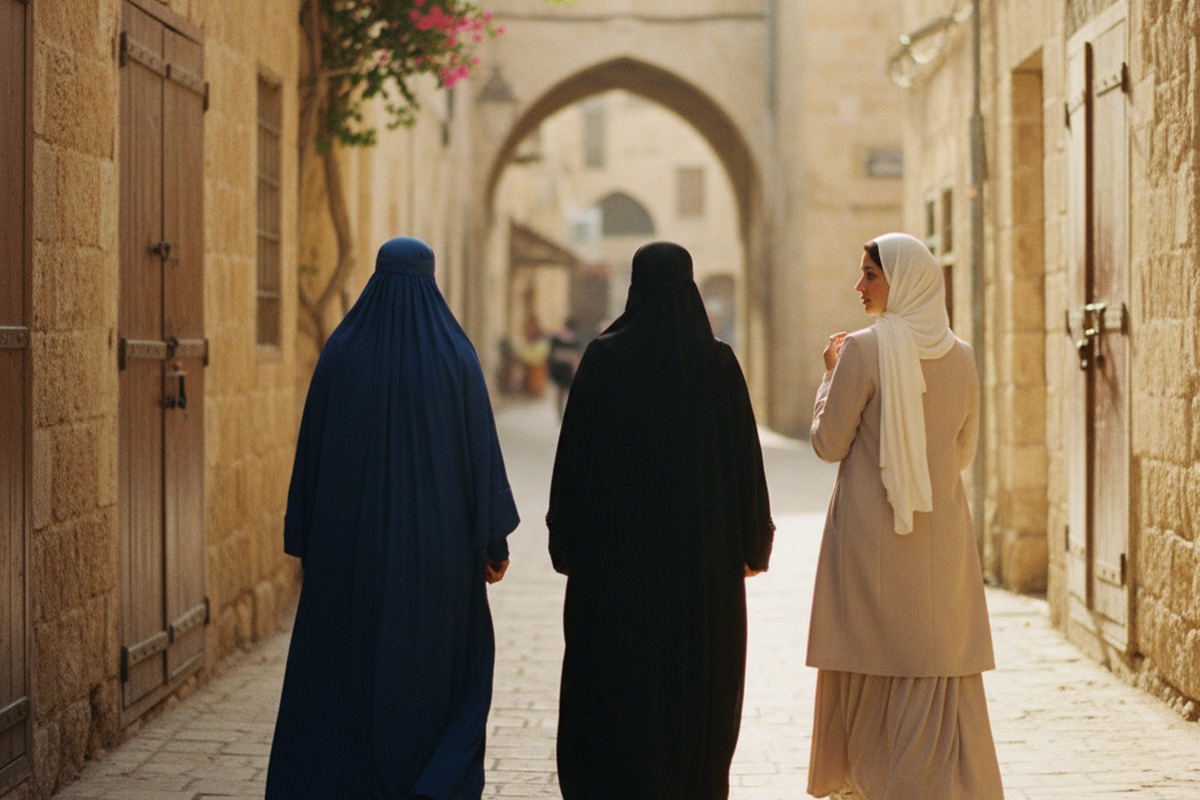
The difference is coverage. A hijab covers the hair, ears, and neck while leaving the face visible. A niqab covers the face except for the eyes and is usually worn with a headscarf and a loose robe. A burqa covers the whole body and the entire face, with a mesh screen or grille over the eyes so the wearer can see out.
The terms are often confused, but they are not interchangeable. All three are forms of Islamic modest dress worn by some Muslim women, shaped by region, religious interpretation, family tradition, and personal choice. The hijab is by far the most common worldwide. The niqab is worn by a smaller number of women, often in Gulf Arab countries and parts of South Asia. The full burqa is most associated with Afghanistan. The distinction matters because news coverage and political debate often use the words loosely.
The hijab: headscarf only
The hijab is the least concealing of the three and the most widely worn. In Arabic, “hijab” can broadly mean “barrier” or “partition,” but in modern everyday use it often means the headscarf worn by many Muslim women.
It wraps around the head to cover the hair, ears, and neck, usually pinned or tucked in place. The face is visible, including the chin in most styles. Hijabs come in many regional and fashion variations, from simple wraps to more elaborate draped styles, and they are usually worn with regular modest clothing rather than a special robe.
The niqab: face veil with eyes showing
A niqab is a face veil. It covers the lower face and often most of the upper face, leaving the eyes visible. It is normally worn with a headscarf that covers the hair and often with an abaya or another loose outer garment. A half niqab covers the lower face while leaving the forehead and eyes open; a full niqab leaves only a narrow eye opening.
It is most common in the Arabian Peninsula, especially Saudi Arabia and other Gulf states, and also appears in parts of South Asia and North Africa. The open eyes are what separate it from a burqa, while the covered face separates it from a hijab.
The burqa: full coverage including the eyes
The burqa is the most concealing of the three. It covers the entire body and face, including the eyes, which are hidden behind a mesh screen or grille. The classic Afghan burqa is usually a single garment draped from the top of the head over the whole body. It became internationally known through its association with Afghanistan, especially during Taliban rule, but it is far less common globally than the hijab or niqab. The key distinction is that a niqab leaves the eyes visible; a burqa covers them.
Why the terms get confused
The confusion is common in Western media and political debate. Many people outside Muslim-majority societies do not know the distinctions, and “burqa” is sometimes used as a catch-all for any face covering, even when the garment being discussed is more likely a niqab.
Regional vocabulary also varies, so the same or similar garments may have different names across countries and languages. The quick rule is still simple: hijab covers the hair, niqab covers the face but shows the eyes, and burqa covers the face and eyes.
Other related garments
Other garments often appear in the same discussion. A chador is a full-body cloak common in Iran; it wraps around the body and usually does not cover the face. An al-amira is a two-piece headscarf with a fitted cap and tube-like scarf. A shayla is a long rectangular scarf wrapped around the head, common in the Gulf.
A khimar is a longer cape-like scarf that covers the hair, neck, and shoulders, sometimes down to the waist, while leaving the face clear. A dupatta is a long South Asian scarf that may be worn loosely over the head. These differences reflect country, community, family tradition, religious interpretation, and individual choice.
Takeaway
The hijab, niqab, and burqa differ by coverage. A hijab covers the hair, ears, and neck while leaving the face visible, and it is the most common worldwide. A niqab covers the face except for the eyes, usually with a headscarf and loose robe, and is most common in Gulf Arab countries and parts of South Asia.
A burqa covers the whole body and the face, including the eyes behind a mesh screen, and is most associated with Afghanistan. The simple rule: hijab covers hair, niqab covers the face but shows the eyes, and burqa covers the face and eyes.
