

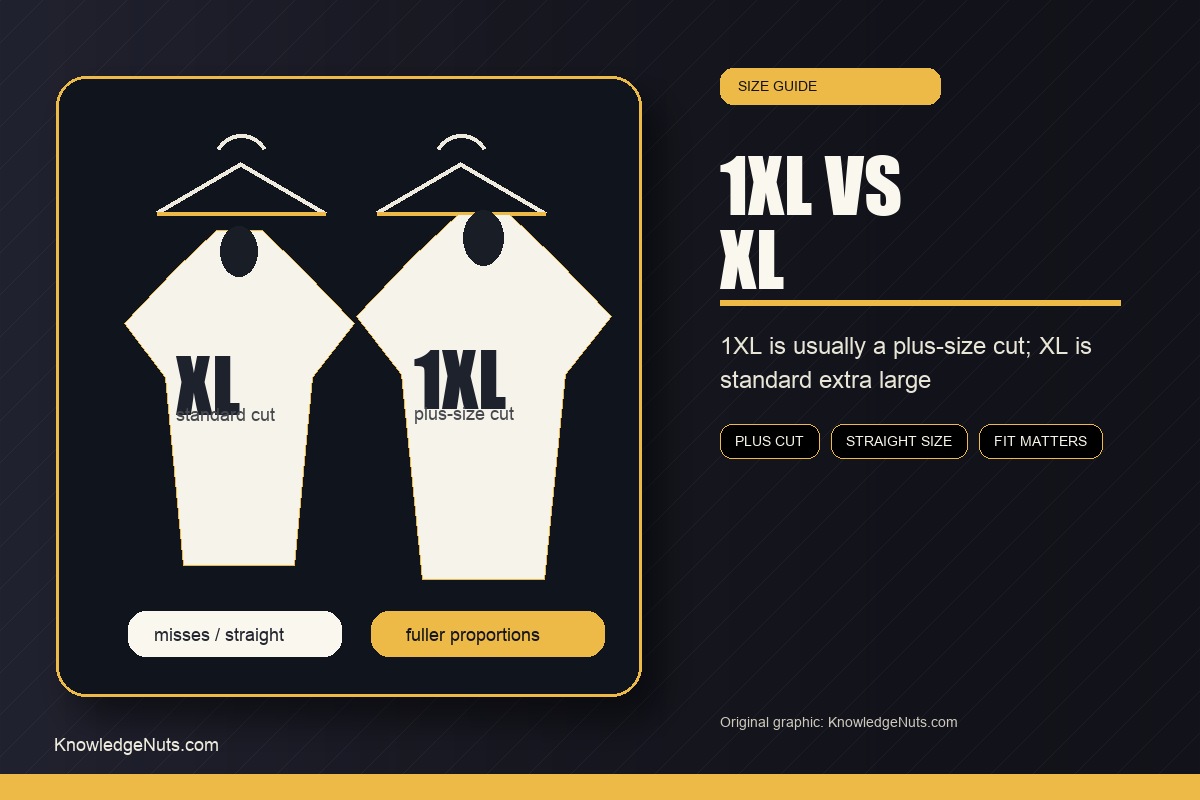
In women’s clothing, “XL” and “1X” (sometimes written as “1XL”) are two different size designations that often overlap in basic measurements but use different sizing systems. The two are not interchangeable: an XL and a 1X from the same brand can fit very differently.
XL is part of the standard misses (or straight-size) sizing system. Standard sizes typically run XS, S, M, L, XL, XXL. They’re designed for women with standard body proportions.
1X (or 1XL) is part of the plus-size sizing system, which typically runs 1X, 2X, 3X, 4X. Plus-size garments are cut with different proportions: more room in the bust, hips, and arms, and longer body lengths to accommodate fuller body types.
The difference is in measurements, proportions, and cut. A 1X garment is not simply a bigger XL; it is cut with more room through the bust, hips, arms, and often the torso.
Here is how XL and 1X differ when you are shopping.
What XL means
XL stands for “Extra Large” and is part of the standard misses (also called straight-size or regular-size) sizing system in women’s clothing.
Defining traits of XL:
- Standard misses sizing system
- Typically corresponds to US numeric sizes 14-16
- Bust: 41-43 inches typical
- Waist: 33-35 inches typical
- Hips: 43-45 inches typical
- Cut for proportional standard-size body
- Sleeve and torso length match standard sizing
- Found at: most mainstream retailers
- Available in tops, bottoms, dresses
Common XL applications:
- Mainstream fashion retailers (Zara, H&M, Gap, Old Navy)
- Department stores (regular department, not plus)
- Athletic wear and casual clothing
- Maternity wear (sometimes overlaps)
- Often the largest size in the standard misses range
XL often sits at the edge of the regular-size range, right before plus sizing begins. Many shoppers in this range move between XL and 1X based on the brand, fabric, and cut.
What 1X (1XL) means
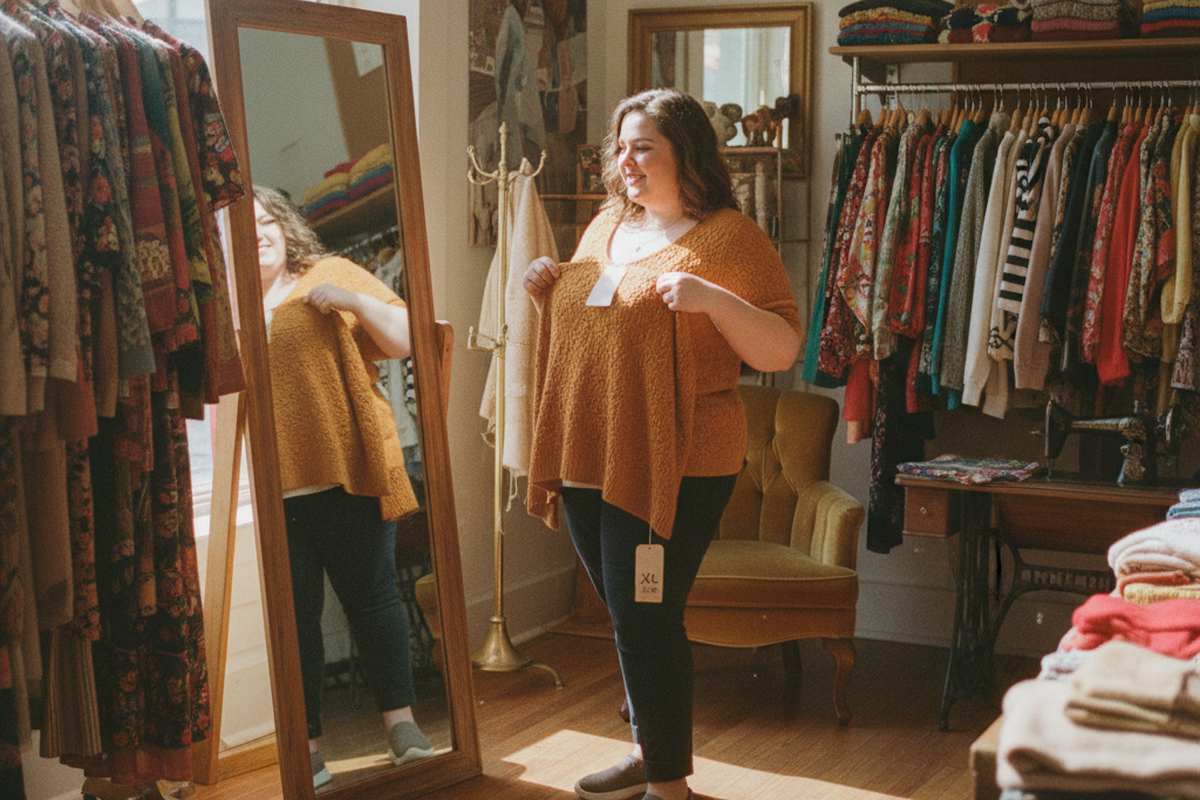
1X (often written as 1XL) is the smallest size in the plus-size sizing system. It’s designated for women with fuller body proportions.
Defining traits of 1X (1XL):
- Plus-size sizing system
- Typically corresponds to US numeric sizes 14W-16W
- Bust: 42-46 inches typical
- Waist: 34-37 inches typical
- Hips: 46-49 inches typical
- Cut for fuller body proportions (more room in bust, hips, arms)
- Slightly longer body length than equivalent misses sizes
- Found at: plus-size sections and plus-size retailers
- Available primarily in tops, bottoms, dresses
Common 1X applications:
- Plus-size focused retailers (Lane Bryant, Torrid, Eloquii, Dia & Co)
- Plus sections at department stores
- Plus-size athletic wear
- Specialty plus-size brands
A 1X cut allows more room throughout the garment. That usually means more room through the bust, fuller hips, roomier arms, and a slightly longer torso.
Side-by-side comparison
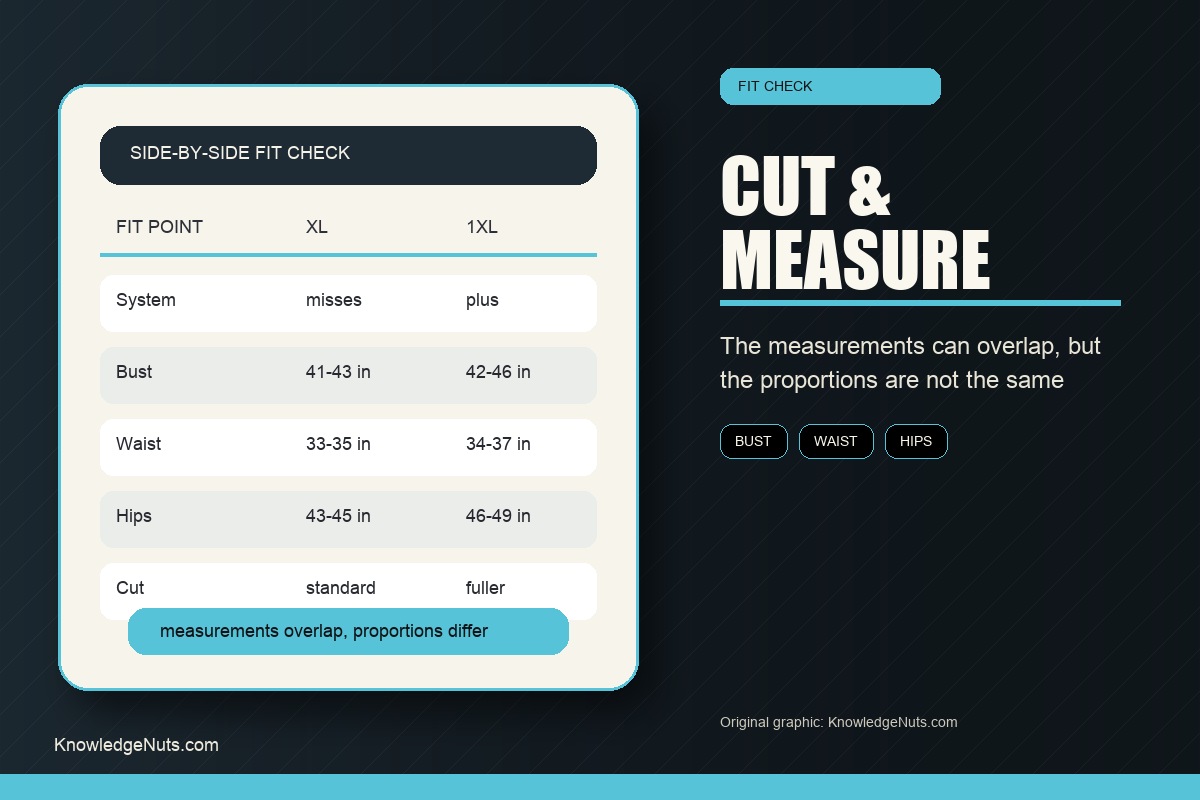
The comparison looks like this:
| Feature | XL (Misses) | 1X (Plus) |
|---|---|---|
| Sizing system | Standard misses | Plus-size |
| US numeric range | 14-16 | 14W-16W |
| Bust (typical) | 41-43″ | 42-46″ |
| Waist (typical) | 33-35″ | 34-37″ |
| Hips (typical) | 43-45″ | 46-49″ |
| Cut | Standard proportions | Fuller proportions |
| Body length | Standard | Slightly longer |
| Sleeve fit | Standard | Roomier |
| Where sold | Mainstream retailers | Plus-size sections/retailers |
| Number after the X | XL = “Extra” L | 1X = first plus size |
| Larger sizes | XXL (or 2XL) next | 2X, 3X, 4X next |
Women in this range should try both XL and 1X to see which fits. The fit can vary widely by body shape.
Sizing systems explained
Standard misses sizing:
- Cut for “standard” body proportions
- Numeric sizes: 0, 2, 4, 6, 8, 10, 12, 14, 16
- Letter sizes: XS, S, M, L, XL (sometimes XXL)
- Designed around standard misses fit models and proportions
- Fit: relatively closer to body, especially at bust and hips
Plus-size sizing:
- Cut for fuller body proportions
- Numeric sizes: 14W, 16W, 18W, 20W, 22W, 24W, 26W, 28W (and beyond)
- Letter sizes: 1X (or 1XL), 2X, 3X, 4X (and beyond)
- Designed with extra room in bust, waist, hips, and arms
- Often longer body length to accommodate height differences
- Fit: typically more relaxed/draped
The same number can fit differently in misses and plus sizing. A misses 14 and a plus 14W are not cut the same; the “W” marks a plus-size cut.
Where they overlap and don’t
Overlap zones:
- Both XL and 1X cover roughly the size range US 14-16
- A woman who wears US 14 might fit either an XL or a 1X depending on body shape
- For some brands, XL and 1X have similar measurements but different cuts
Where they don’t overlap:
- XL is the largest in straight sizes; 1X is smallest in plus
- The cut and proportions are different
- Plus-size has more sizes above 1X (2X, 3X, 4X)
- Straight sizing rarely goes above XL or 2XL
Body shape considerations:
- Athletic/proportional XL body: XL fits well
- Curvier with fuller bust/hips: 1X often fits better even at the same numeric size
- Apple shape (more weight around the middle): may prefer 1X for room
- Rectangle shape: XL may fit fine
Brand variations
Sizing varies a lot by brand. Some examples:
| Brand | XL bust | 1X bust |
|---|---|---|
| Old Navy | 41-43″ | 44-46″ |
| Target | 41-43″ | 43-45″ |
| Lane Bryant | (no XL, plus-only) | 44-46″ |
| Torrid | (no XL) | 44-46″ |
| Universal Standard | Has both XL and 1X | Similar fit range, depending on item |
| H&M | 41-43″ | 43-45″ |
Some brands now offer extended sizing with XL/XXL/3XL going up to plus-equivalent measurements. Other brands separate strictly between standard XL and plus 1X.
For the best fit, check the brand’s size chart instead of relying only on the letter or number.
Plus-size designations
The plus-size labeling system:
- W = Women’s (plus-size designation, e.g., 14W, 16W, 18W)
- X = denotes plus size in letter system (1X, 2X, 3X)
- 1X = roughly 14W-16W
- 2X = roughly 18W-20W
- 3X = roughly 22W-24W
- 4X = roughly 26W-28W
Number-style sizes use the W:
- 14W (plus 14)
- 16W (plus 16)
- 18W (plus 18)
Letter-style use the X:
- 1X
- 2X
- 3X
In plus sizing, 1X is usually the first size. In standard misses sizing, XL is usually near the top of the range.
Common confusions
A few things people often get wrong:
- “1XL” and “1X” are usually the same size designation, just with different abbreviations.
- XL is NOT the same as 1X. They use different sizing systems and have different cuts.
- A “size 14” in misses is different from a “size 14W” in plus. Same number, different sizing.
- A 1X is the smallest plus size, not the largest.
- Plus-size brands often start their sizing at 1X (no XL option in plus stores).
- XXL or 2XL in straight sizing is NOT the same as 2X in plus sizing. They use different proportions.
- Some brands (Universal Standard, Eileen Fisher) use unified sizing that doesn’t distinguish straight and plus.
How to choose
Choose XL (standard misses) if:
- You wear US 14-16 and have proportional body shape
- You usually shop at mainstream retailers
- Your bust, waist, and hips are roughly the same proportions as smaller misses sizes
- The XL of your favorite brand fits well
- You’re looking at clothing only available in misses sizing
Choose 1X (plus) if:
- You wear US 14-16 but have fuller bust, hips, or arms
- You find XL clothing tight in some areas (often bust or hips)
- You shop at plus-size retailers or sections
- You prefer the extra room in arms and torso
- You need clothing only available in plus sizing
For someone unsure: if available, try both an XL from a misses section and a 1X from a plus section. The one that fits better, looks better, and feels more comfortable is your size.
Pricing
Pricing for similar garments:
- XL (standard misses): same as smaller misses sizes
- 1X (plus): often slightly more (5-15% premium common)
The slight premium for plus sizes comes from:
- More fabric required
- Different production runs
- Smaller market in some categories
- Specialty cut/grading
Some brands now charge the same for plus and straight sizes. The trend is toward equality, but plus-size premiums still exist at many retailers.
The simple summary
XL is the largest size in the standard misses sizing system, designed for women with standard body proportions in the size 14-16 range. 1X (or 1XL) is the smallest size in the plus-size sizing system, designed for women with fuller body proportions in roughly the same size range.
The main difference is cut and proportion: 1X has more room in the bust, hips, and arms, plus a slightly longer body length. XL fits closer to standard misses proportions.
For someone in the US 14-16 range, either could work depending on body shape. Trying both at retailers that carry both is the best way to determine which fits better. Plus-size 1X is typically priced 5-15% more than misses XL of the same brand.
