

Weasels and minks are both members of the Mustelidae family, the same family as otters, badgers, ferrets, and martens. They look similar from a distance: long-bodied, short-legged, sleek-furred predators. But they’re different species with different sizes, habitats, and behaviors.
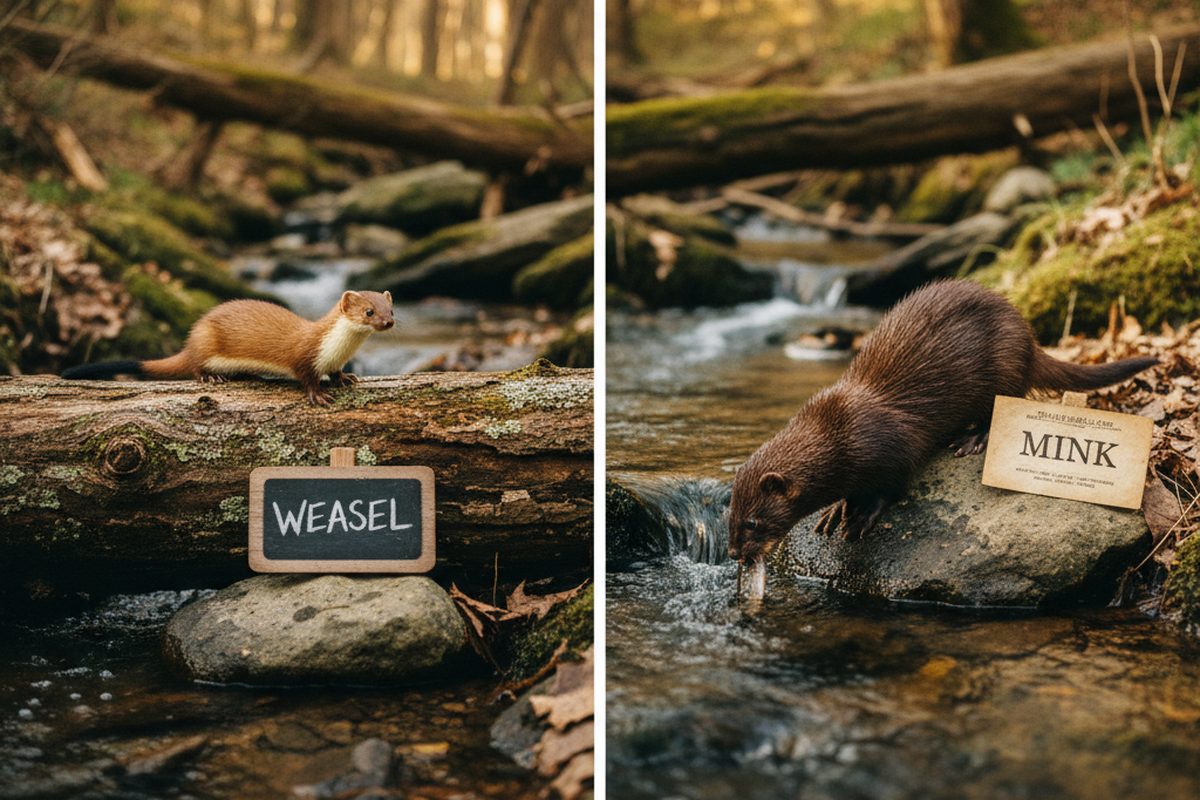
A weasel is small (typically 4-16 inches long including tail), often with a brown back and white belly, and frequently a black-tipped tail. The most common North American species is the long-tailed weasel. Weasels live mostly on dry land and hunt small rodents, rabbits, and birds.
A mink is larger (typically 12-28 inches long), uniformly dark brown all over, with a slightly bushy tail and visible webbing between the toes. Minks are semi-aquatic, strong swimmers, and hunt fish, frogs, crayfish, waterfowl, and small mammals near water.
The Mustelidae family includes about 65 species worldwide, and weasels and minks are among the more familiar North American members. They are closely related, but they are not the same animal; weasels are in Mustela, while the American mink is usually placed in Neovison and the European mink in Mustela.
What a weasel is

A weasel is a small predator in the genus Mustela. Several species exist; in North America the three native ones are the long-tailed weasel, the short-tailed weasel (also called ermine or stoat), and the least weasel.
Defining traits of weasels:
- Small body: 4-16 inches total length depending on species
- Slim, elongated body, short legs
- Brown back, white or cream belly (most species)
- Black-tipped tail in long-tailed and short-tailed weasels
- Some species (short-tailed weasel/ermine) turn white in winter in northern climates
- Diet: primarily small rodents (mice, voles, rats), rabbits, birds, eggs
- Habitat: forests, fields, hedgerows, farmlands
- Mostly terrestrial (on land, not in water)
- Active year-round
- Solitary except during mating
Common weasel species in North America:
- Long-tailed weasel (Mustela frenata): 12-16 in including tail, most common in lower 48
- Short-tailed weasel / ermine / stoat (Mustela erminea): 8-13 in, white in winter
- Least weasel (Mustela nivalis): 4-8 in, smallest carnivore in the world
- American mink (Neovison vison): formerly classified as Mustela; technically not a weasel
Weasels are unusually capable hunters for their size. A 4-ounce least weasel can take down a rabbit five times its weight.
What a mink is
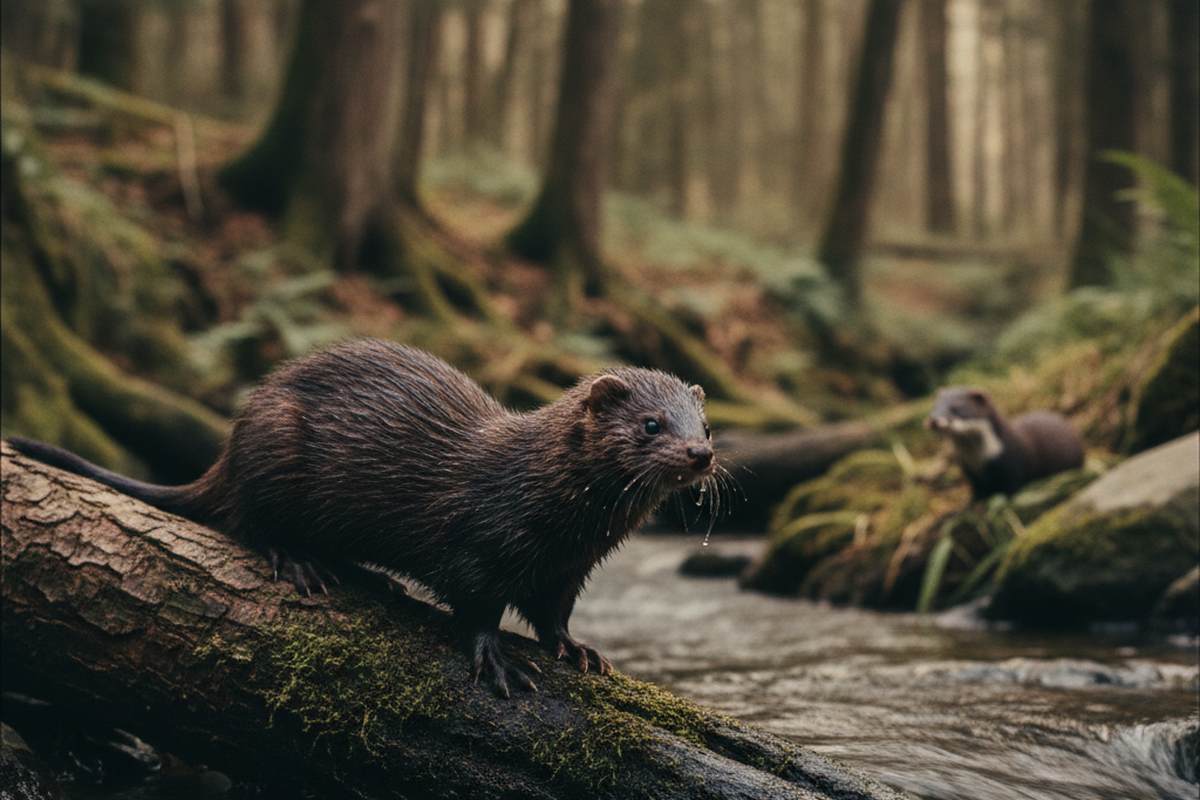
A mink is a semi-aquatic mustelid. Two species exist: the American mink (Neovison vison, native to North America) and the European mink (Mustela lutreola, much rarer). The American mink is far more common.
Defining traits of minks:
- Larger than weasels: 12-28 inches total length
- Heavier build (1-3 pounds typical)
- Uniformly dark brown to nearly black, with white chin or chest patch
- Bushy tail, slightly more rounded
- Partially webbed feet
- Diet: fish, frogs, crayfish, waterfowl, small mammals, eggs
- Habitat: rivers, lakes, marshes, coastal areas
- Strong swimmer; can dive 16 feet deep
- Mostly nocturnal
- Solitary
- Den near water in burrows or under tree roots
The American mink is also farm-raised for fur, and escaped/released farmed minks have established populations across Europe (an invasive species there).
The easiest visual clue is the belly. A weasel usually has a clear contrast between brown back and pale belly, while a mink is dark brown over most of the body.
Side-by-side comparison
The comparison looks like this:
| Feature | Weasel | Mink |
|---|---|---|
| Family | Mustelidae | Mustelidae |
| Genus | Mustela | Neovison (American), Mustela (European) |
| Total length | 4-16 in | 12-28 in |
| Weight | 1-15 oz | 1-3 lb |
| Body color | Brown back, white belly | Uniformly dark brown |
| Tail | Often black-tipped | Bushy, all dark |
| Winter coat (some species) | Turns white | Stays brown |
| Webbed feet | No | Partial |
| Habitat | Land (forests, fields) | Water (rivers, marshes) |
| Diet | Rodents, rabbits, birds | Fish, frogs, waterfowl, mammals |
| Swimming | Capable, not preferred | Excellent swimmer |
| Activity | Day and night | Mostly nocturnal |
| Range (North America) | Across most of US | Most of US except Southwest |
For a quick field ID, start with size, location, and belly contrast. A small land animal with a pale belly is more likely a weasel; a larger dark animal near water is more likely a mink.
How to identify them in the wild
Quick visual ID:
- Small (under 1 lb), brown with WHITE belly, black tail tip: weasel
- Larger (1-3 lb), uniformly DARK BROWN all over, near water: mink
- Brown body in summer, all white with black tail tip in winter: ermine (a weasel)
- Tiny (under 8 inches): least weasel
Behavior clues:
- Hopping/bounding through grass, hunting voles or mice: likely weasel
- Swimming in a stream or sitting on a log over water: likely mink
- Diving and chasing fish: mink
- Standing upright on hind legs to scan: weasel (and mink, but more often weasel)
- Active in daylight: weasel more likely
- Nocturnal sighting: mink more likely
Track patterns:
- Small (1/2 to 1 inch wide), 4 toes visible: weasel
- Larger (1-2 inches wide), 5 toes visible, web prints: mink
Habitat and range
Weasel habitats:
- Long-tailed weasel: throughout the contiguous US, southern Canada, Mexico, Central America
- Short-tailed weasel/ermine: northern US, all of Canada, Alaska, Eurasia
- Least weasel: northern US states, Canada, Eurasia
- All species prefer brushy fields, forest edges, farmland, suburban areas
- Avoid deep water but will swim short distances
Mink habitats:
- American mink: across all of US except some Southwest, all of Canada
- Always near water, rivers, streams, lakes, marshes, coastal estuaries
- Den in bank burrows, hollow logs, under tree roots
- Will travel long distances along waterways
- European mink: rare, isolated populations in Europe
Where both occur, mink sightings usually say more about nearby aquatic habitat, while weasel sightings often track rodent-rich fields, hedgerows, and forest edges.
Other related species (for context)
The mustelid family includes several similar-looking animals:
- Otter: much larger than mink, fully aquatic, distinctive flat head
- Marten / sable: tree-dwelling, larger than weasel, brown with creamy throat
- Fisher: larger forest-dwelling weasel relative
- Wolverine: largest mustelid, 30+ pounds, found in northern wilderness
- Badger: stocky, broad, ground-dwelling, distinct face stripes
- Ferret (domestic): related to European polecat (a wild weasel relative); fully domesticated
- Polecat: wild ancestor of ferret, found in Europe
For comparison purposes, weasels and minks are at the small end of the mustelid spectrum; otters and wolverines are at the large end.
Hunting behavior
Weasels:
- Hunt by following scent trails of small rodents
- Can pursue prey into burrows (their slim body squeezes through tight spaces)
- Often kill with a bite to the back of the neck
- Cache surplus prey in burrows for later
- Active hunters during both day and night
- Take prey larger than themselves
Minks:
- Hunt both on land and in water
- Diving for fish and crayfish; chasing on land
- Carry larger prey to a feeding spot
- Often kill multiple prey items in a single hunting session
- More dependent on aquatic prey
- Will raid duck nests and eat ducklings
Both are efficient predators for their size. They can become problems around chicken farms, fish hatcheries, and game-bird operations.
Mink farming and fur
Minks have an extensive history in fur farming. American mink were first commercially farmed in the 1860s. Today, China, Denmark, Poland, and the Netherlands are major producers. The industry has declined since the 2010s due to ethical concerns and COVID-19 outbreaks at mink farms.
Wild minks are sometimes hunted for fur, but most commercial mink fur comes from farms.
Weasels are not commonly farmed. Their fur is used in some contexts (especially the white winter pelt of ermine, historically used for royal robes), but it’s a minor industry compared to mink.
Common confusions
A few things people often get wrong:
- A “ferret” is not a wild weasel. Domestic ferrets are descended from European polecats (a related wild species).
- An “ermine” and a “stoat” are the same animal (Mustela erminea), different names for the same species.
- A “marten” is a separate, larger, tree-dwelling mustelid, not a weasel or mink.
- A weasel and a mink can both have black-tipped tails, but the mink’s whole body is darker.
- “Mink coat” almost always refers to American mink (farmed); other mustelid furs (ermine, sable, marten) are different products.
- Both groups have native species in North America and Europe, though the exact species differ by region.
- A “least weasel” is the smallest carnivore in the world, adults sometimes weigh under 2 ounces.
When you might see one
Weasel sightings:
- Brushy field edges
- Stone walls, woodpiles, brush piles
- Near barns or chicken coops
- Suburban yards (especially with bird feeders or rodent populations)
- Snowy fields in winter (if it’s an ermine, white winter coat stands out)
Mink sightings:
- Riverbanks, lake shores, beaver ponds
- Dock pilings near water
- Fish hatcheries (a problem species)
- Wetlands at dusk
- Coastal salt marshes
Both are common in the right habitat but hard to see up close. Game cameras and tracks near water are often the best ways to confirm which animal is present.
The simple summary
A weasel is a small (4-16 inch), land-based mustelid with brown back, white belly, and often a black-tipped tail. It hunts mainly small rodents and rabbits in fields and woodlands. A mink is a larger (12-28 inch), semi-aquatic mustelid with uniform dark brown fur, found near water. It hunts fish, waterfowl, and aquatic prey.
Both are members of the Mustelidae family. In the wild, the easiest clues are size, habitat, and belly color. If the animal darted through a field, think weasel first. If it swam past a kayak or moved along a riverbank, mink is more likely.
