

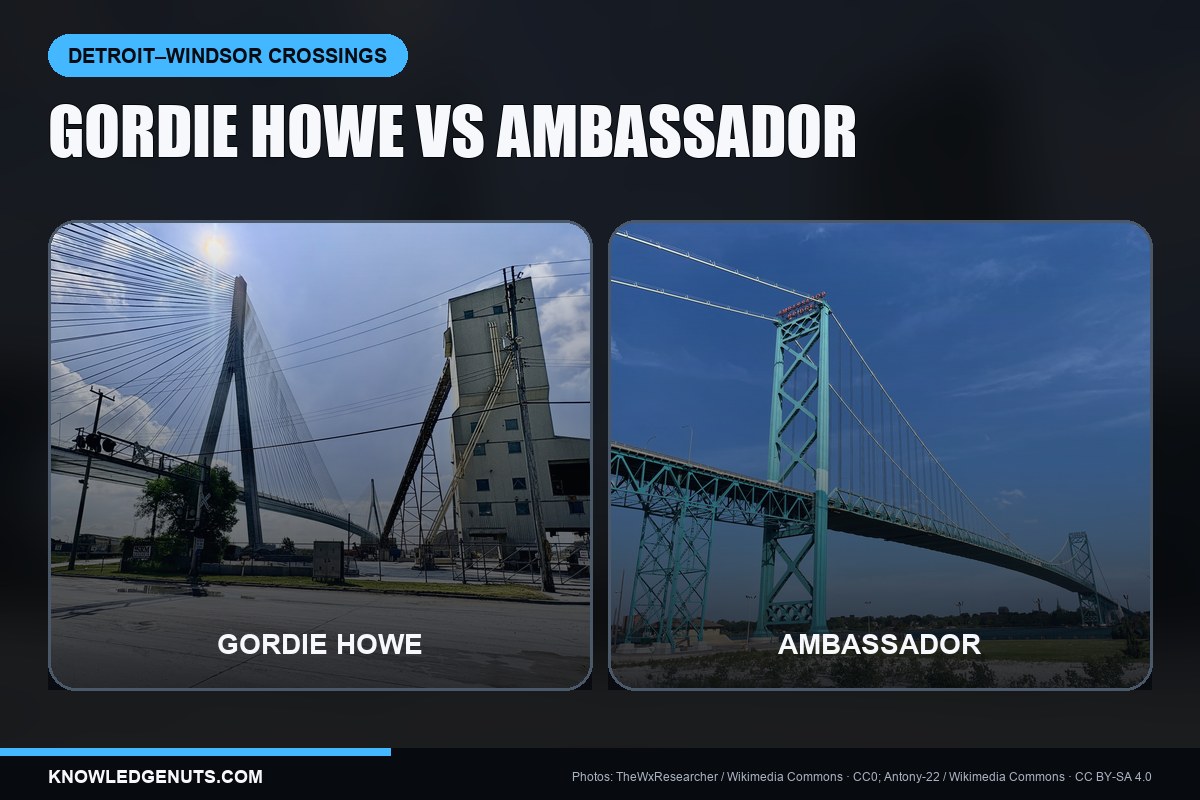
The Gordie Howe International Bridge will be a publicly owned, six-lane crossing several miles south of the Ambassador Bridge, with a direct link between Interstate 75 and Highway 401. The Ambassador is the privately owned, four-lane crossing that has operated since 1929, closer to central Detroit and Windsor. The choice is therefore not simply new versus old: the bridges differ in route, border facilities, ownership, walking and cycling access, and toll programs.
Travelers will have that second bridge choice after the Gordie Howe opens. The bridge is scheduled to open on July 27, 2026, following a July 10 announcement by Canada and Michigan.
The two bridges at a glance
| Feature | Gordie Howe International Bridge | Ambassador Bridge |
|---|---|---|
| Status | Scheduled to open July 27, 2026 | Open since 1929 |
| Vehicle lanes | Six, three in each direction | Four |
| Location and route | South of the Ambassador; will connect I-75 directly to Highway 401 without traffic lights | Closer to the two downtowns; the Ontario approach uses Windsor city streets before reaching Highway 401 |
| Ownership and operation | Owned equally by Canada and Michigan; operation and maintenance are delivered under the project’s public-private contract | Privately owned and operated through companies controlled by the Moroun family |
| Border control | Canadian and U.S. border agencies control inspection and admission | Canadian and U.S. border agencies control inspection and admission |
| Walking and cycling | Will have a free, two-way multi-use path | No routine public foot or bicycle crossing |
The Gordie Howe’s ownership has separate public and contractual layers. Canada and Michigan share ownership, while WDBA oversees the public project. Operation and maintenance are delivered under the project contract. WDBA itself is a wholly Canada-owned Crown corporation. The Ambassador has no comparable public co-owner: its private owner-operator is associated with the Moroun family, while government agencies still control customs and admission.
Why a second bridge adds more than pavement
Crossing performance depends on approach roads, toll lanes, customs inspection, and onward roads as well as the span over the river. A second bridge can add another route and another pair of border facilities even though the Detroit-Windsor Tunnel and other regional crossings already offer alternatives.
The Ambassador has long carried a major share of cross-border commerce. More than $140 billion in merchandise trade crossed it in 2021. That figure does not establish that the existing corridor lacks inspection capacity, so the narrower point matters: the Gordie Howe will add another pair of border inspection facilities and another route across the river.
Those additional facilities cannot guarantee a delay-free trip. Demand, inspections, incidents, and staffing can still produce queues. They will, however, give cars and trucks another place to cross and give the regional network another route when one crossing is congested or disrupted.
The better route depends on where the trip begins and ends
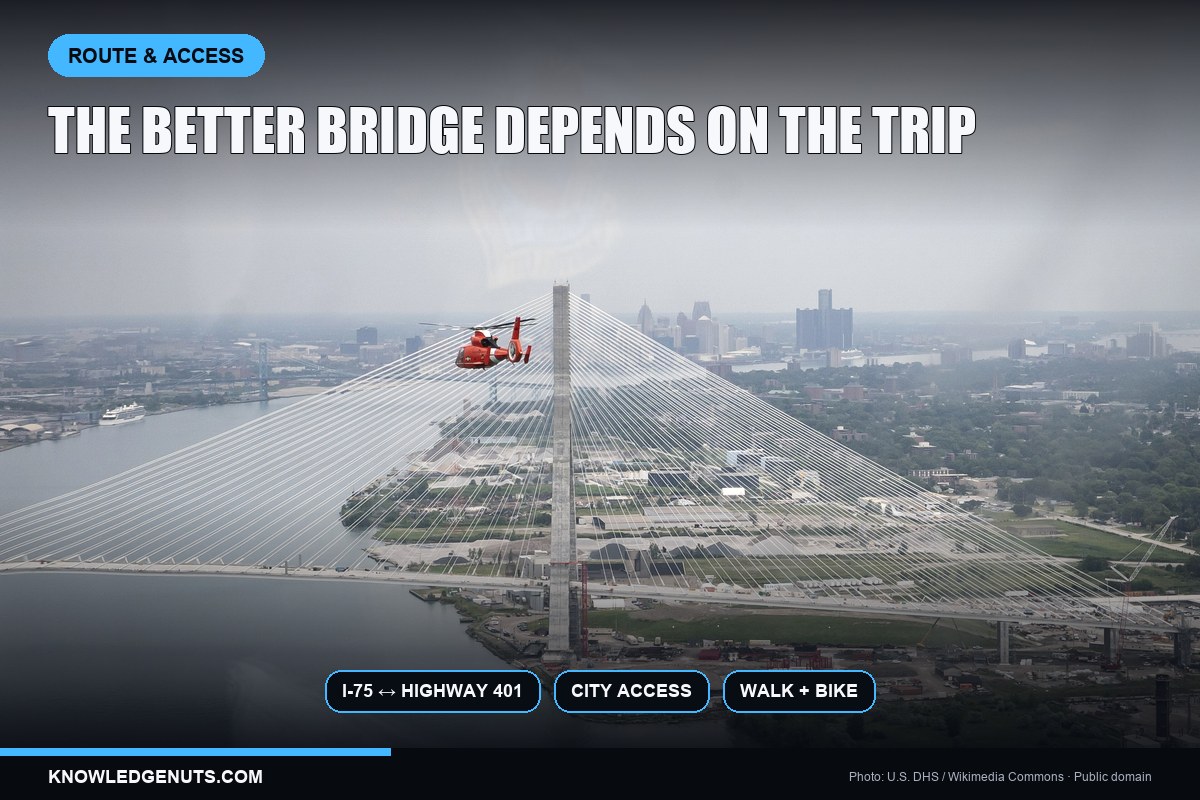
When it opens, the Gordie Howe will connect I-75 directly to Highway 401 without traffic lights. That should make it the natural first comparison for trucks and travelers passing through Windsor rather than stopping in the city.
The Ambassador sits a few miles north, closer to central Detroit and Windsor. On the Canadian side, traffic reaches the Highway 401 corridor through Windsor streets rather than an uninterrupted freeway link. That can be a disadvantage for through freight, but the location can favor trips beginning or ending near the two city centers. The Detroit Free Press International Marathon, for example, plans to retain its Ambassador Bridge route because the Gordie Howe is farther from the event’s traditional start and finish.
Newer will not mean faster for every trip. A downtown destination may favor the Ambassador, while a long-distance I-75–Highway 401 trip may favor the Gordie Howe. Live queues, road incidents, vehicle restrictions, and the traveler’s actual endpoint can reverse either expectation.
Structurally, the Gordie Howe is cable-stayed, while the Ambassador is a suspension bridge. The Ambassador opened in 1929, and the Moroun family gained control in 1979. The engineering contrast explains their different silhouettes, but their approaches and border facilities will matter more to most drivers.
Toll comparisons need a date and a payment method
The available 2026 figures show why a single “which bridge is cheaper?” answer can mislead. For a one-way passenger crossing, the Gordie Howe’s announced standard launch rate is CAD$8 or US$5.75, with a lower account rate of CAD$6 or US$4.35. The Ambassador publishes its own passenger schedule, and the relevant price can depend on the direction, currency, vehicle and payment program. A useful comparison therefore has to use both operators’ live schedules for the same trip.
For commercial vehicles, the Gordie Howe’s announced standard rate is CAD$12 or US$8.75 per axle. The Ambassador’s quoted June 2026 rate was US$20 per axle. These are dated, one-way schedule comparisons, not a promise that the same figure applies in both travel directions or after opening-day adjustments.
The systems are separate. An account or discount at one bridge should not be assumed to work at the other. Before leaving, check each operator’s live rate for the direction, currency, vehicle height and axles, trailer, and payment method.
Walking and cycling will be a genuine difference
When the Gordie Howe opens, its separated multi-use path will carry two-way pedestrian and bicycle traffic without a toll. Users will still pass through border inspection and need acceptable identification.
The Ambassador does not offer routine public walking or cycling. Its original eight-foot sidewalk closed after the September 11, 2001 attacks because of security concerns. Controlled events are an exception: international marathon participants still cross the Ambassador as part of the approved course. That exception does not make the sidewalk available for an ordinary trip.
The simplest choice rule is route first, then live conditions and price. Once the Gordie Howe is confirmed open, start with it for through I-75–Highway 401 travel or a walk or bike crossing; keep the Ambassador in the comparison for destinations nearer central Detroit or Windsor. Then verify that day’s operating status, wait, direction-specific toll, payment method, and border requirements before setting out.
