

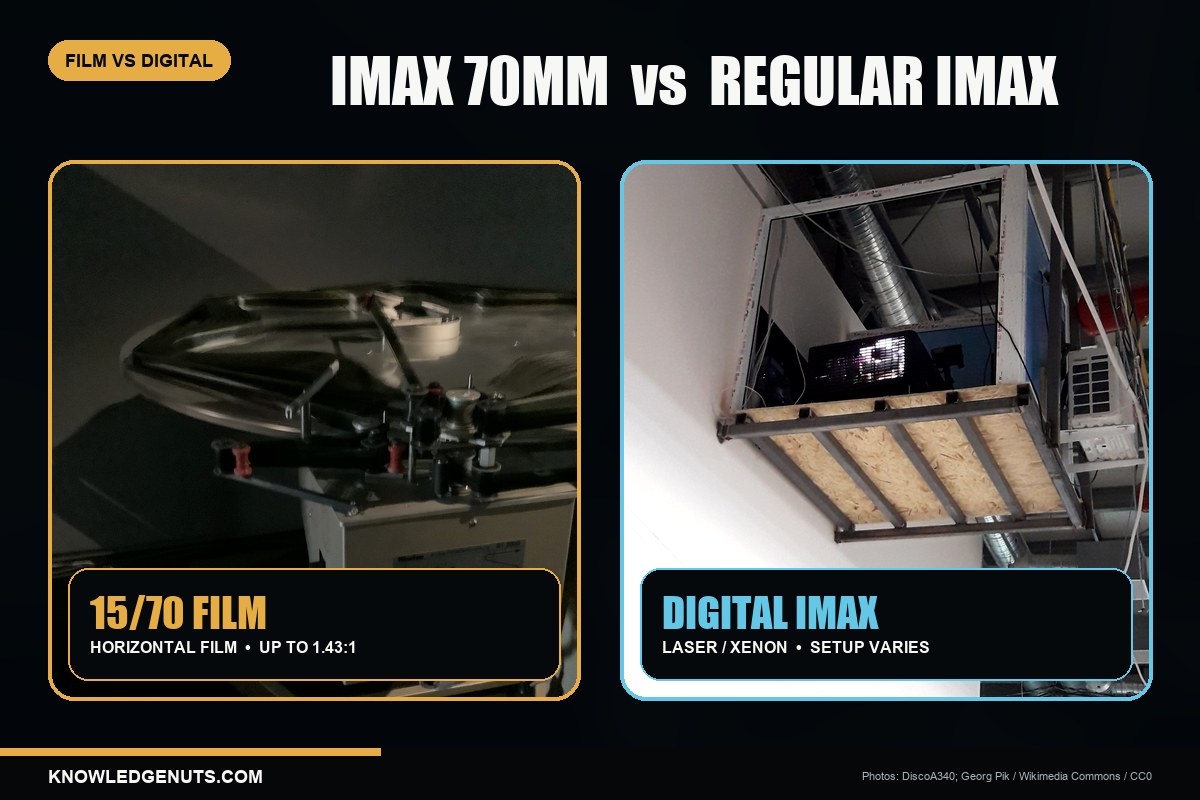
IMAX 70mm is a physical 15-perforation film print that runs horizontally through a specialized projector. A “regular IMAX” ticket usually means a digital presentation, but that phrase is only an informal shortcut: it does not identify one projector, screen shape or aspect ratio.
That is the first distinction to make when buying a ticket. The IMAX name alone does not promise 70mm film or the tall 1.43:1 image. The exact listing and the theater’s equipment determine what will appear on screen.
The Odyssey made the labels matter
Christopher Nolan’s The Odyssey opens July 17, 2026, as the first feature photographed entirely with IMAX film cameras. It is being offered in several versions, including IMAX 70mm film, conventional 70mm film and digital IMAX. Those names may appear beside the same showtime grid even though they describe different prints and projectors.
The rarest option is IMAX 70mm film. IMAX’s own participating list opened with 34 theaters in the United States and Canada, 41 worldwide. Scarcity explains the ticket rush. Knowing what each label promises is how a viewer decides whether the longer trip earns its miles.
Where the 70mm version is playing
IMAX keeps the official participating theater list for The Odyssey, grouped by state and country. The United States entries run from the TCL Chinese Theatres IMAX in Hollywood and AMC Lincoln Square 13 in New York to single museum rooms such as the AutoNation IMAX in Fort Lauderdale and the Indiana State Museum. Canada adds nine locations, and London’s BFI IMAX anchors the short international list.
Bookings extend week by week, so that list is the thing to check rather than any article’s snapshot of it. The busiest rooms were close to sold out at release.
Seventy millimeters can mean two different film frames
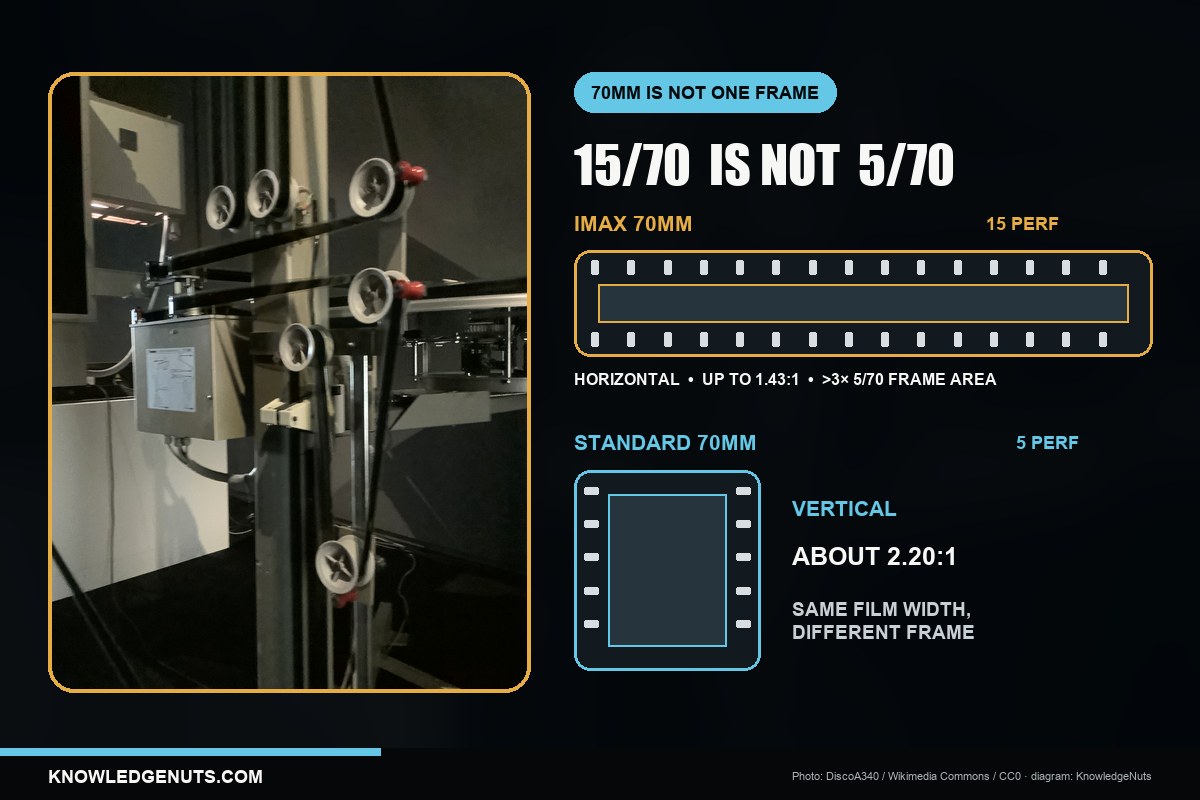
Conventional 70mm and IMAX 70mm use film of the same nominal width, but they send it through the projector in different directions and divide it into different frame shapes.
| Format | Frame notation | Film movement | Typical image shape |
|---|---|---|---|
| Conventional 70mm | 5/70 | Vertical | About 2.20:1 |
| IMAX 70mm | 15/70 | Horizontal | Up to 1.43:1 |
The first number counts the perforations used by each frame. A conventional 70mm frame is five perforations high and moves vertically, much like 35mm film. An IMAX frame stretches across 15 perforations and moves horizontally. Turning the film sideways produces more than three times the frame area of 5/70.
That larger film frame is the heart of the format. It can preserve a tall composition rather than fitting the image into the wide 2.20:1 shape of ordinary 70mm. “Presented in 70mm” therefore does not automatically mean “presented in IMAX 70mm.”
Why a 70mm movie may be shot on 65mm
The camera and theater labels use two numbers for different stages. Large-format camera negative is 65mm wide. The theater release print is 70mm wide, with the additional width historically reserved for soundtrack information. Kodak defines 65mm as a camera format and 70mm as a release-print format.
Descriptions of the same production can therefore say it was shot on IMAX 65mm film and projected from an IMAX 70mm print without contradicting each other. The image originates on the 65mm negative; the release copy loaded into the projector is 70mm.
Regular IMAX is not one technical format
Moviegoers often use “regular IMAX” for any IMAX showing that is not advertised as 70mm film. Most such screenings are digital, but the equipment may be an older xenon system, a single-laser projector or a dual-laser setup.
The available image shape can differ as well. Many digital IMAX presentations reach 1.90:1. If the movie version contains the full frame, a compatible dual-laser system paired with a 1.43:1 screen can present 1.43:1 digitally. A dual laser room with the right screen is a genuine route to the tallest framing rather than a cropped substitute.
Some venues keep both an IMAX 70mm projector and a laser system in the same booth. Branding on the room does not say which machine runs a given show. The schedule listing does.
What actually changes on the screen
When a movie contains full-height 1.43:1 material, the clearest visible difference is the picture above and below a wider version. The official format comparison for The Odyssey illustrates that extra composition, while warning that its diagrams do not represent every auditorium’s physical screen size.
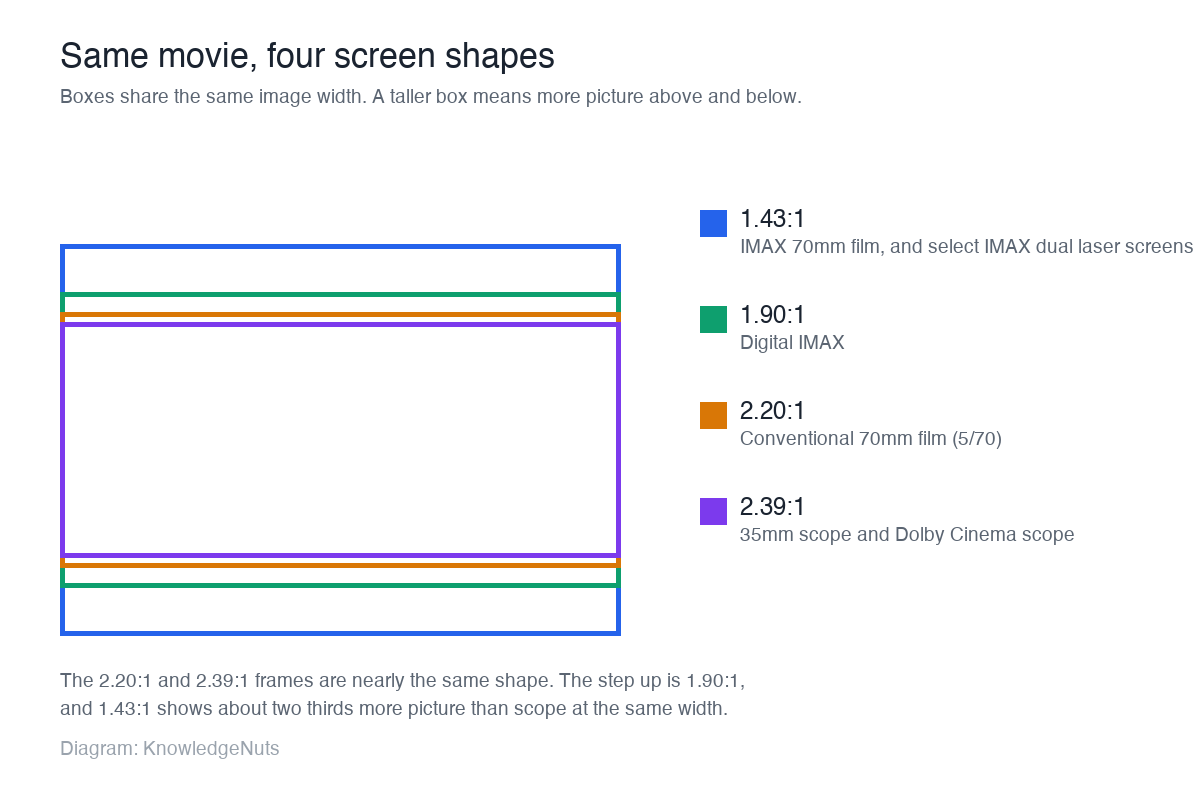
Aspect ratio is only part of the experience. The large film frame, print condition, projector alignment, screen dimensions, seating position and sound system all affect the result. A well-run laser presentation can be more satisfying than a poorly maintained film presentation even when the film version is rarer.
Seating is part of the calculus too. Nolan told the AP he sits near the front in a CinemaScope room, middle of the third row, and “a little behind the center line right up at the middle” in a 1.43:1 IMAX stadium.
Resolution claims need similar caution. Film records grain rather than a fixed pixel grid, so calling IMAX 70mm exactly “18K” forces a pixel score onto an analog image. Compare framing, frame area, projector type, screen capability and the actual venue instead of relying on one K number.
How to read the ticket listing
The wording on the showtime is the actual test:
- IMAX 70mm Film or IMAX 70mm identifies the 15/70 version.
- 70mm by itself usually identifies conventional 5/70 film, not IMAX 70mm.
- IMAX with Laser identifies a digital laser presentation, which may be 1.90:1 or 1.43:1 depending on the supplied version and theater.
- IMAX by itself does not reveal enough. Check the venue’s format page or ask which projector and aspect ratio the show uses.
Buy the format named on the ticket, not the brand name you assume it represents.
