

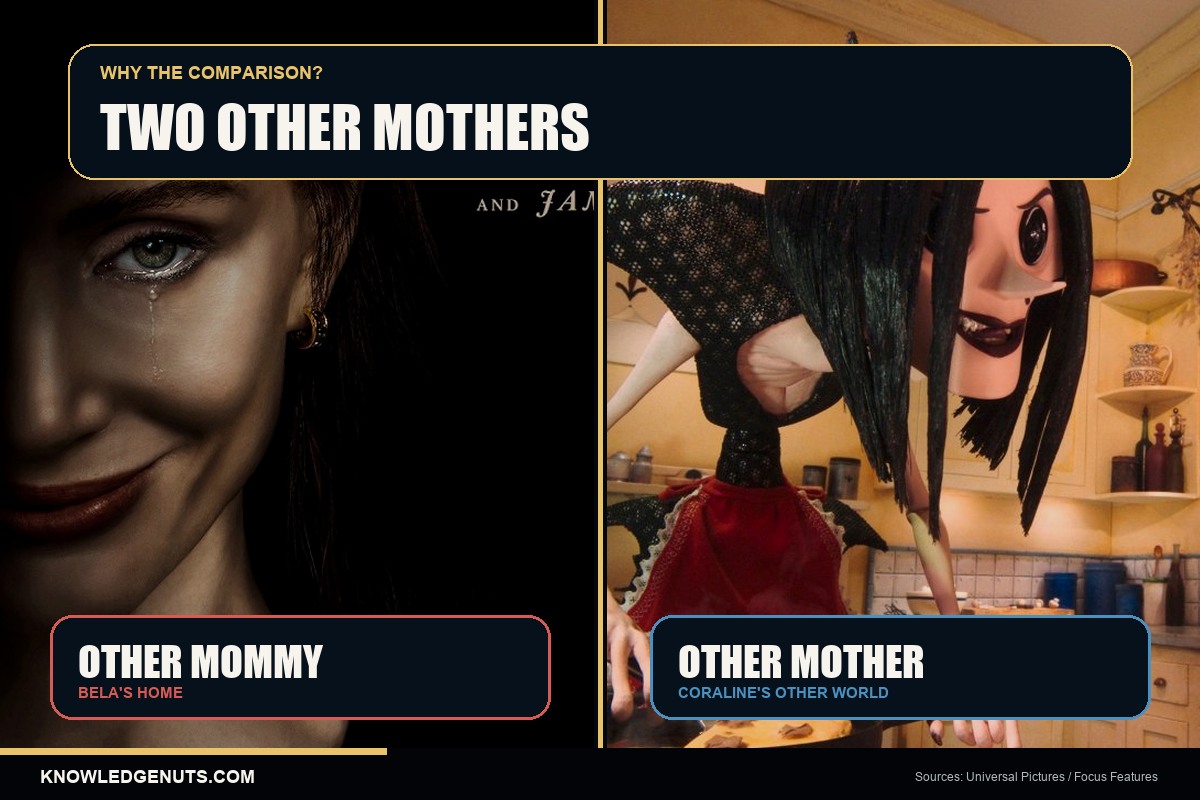
The first online trailer for Other Mommy arrived on July 21, 2026, and the Coraline comparison followed almost immediately. The reason is easy to see: both stories place a child in danger from a creature that looks like her mother, and “Other Mommy” sounds remarkably close to “Other Mother,” the name of Coraline‘s button-eyed villain.
The films are not connected, however. Other Mommy is neither a Coraline remake nor a spinoff. It adapts Josh Malerman’s novel Incidents Around the House, while Coraline comes from Neil Gaiman’s separate novella. The resemblance is a shared horror idea, not a shared fictional universe.
Why the comparison appeared with the trailer
The trailer introduces eight-year-old Bela and a second version of her mother. Jessica Chastain appears as both the ordinary parent and the threatening double, which lets a familiar face shift from comforting to frightening without warning. That mother-shaped doppelganger prompted immediate Coraline comparisons in same-day coverage.
The title does much of the work too. “Other Mommy” sounds like something a frightened child would call a second mother she cannot fully explain. “Other Mother” performs the same job in Coraline: it distinguishes the apparently kinder copy from Coraline’s real parent while warning the audience that something is wrong.
Other Mommy is scheduled to open in theaters on October 9, 2026. Until the finished film is released, the trailer can establish the setup and visual resemblance, but it cannot support theories about the creature’s complete origin or the ending.
Other Mommy comes from Incidents Around the House
The new film is based on Josh Malerman’s 2024 novel Incidents Around the House. Bela lives with Mommy and Daddo in a family already strained by problems between her parents. Another presence lives around the house, and Bela calls it Other Mommy.
Within the book, Bela uses the name as a plain description of a being that behaves like an alternative mother. Other Mommy repeatedly asks whether she can enter Bela’s heart. As the entity becomes more insistent, the weakening trust inside the family makes the house feel less safe.
That premise keeps the threat inside Bela’s existing home and relationships. The horror comes from uncertainty over which mother Bela is seeing, whether the adults believe her and whether her troubled family can protect her. The trailer makes the physical resemblance especially direct by giving Chastain both roles.
Coraline’s Other Mother builds a replacement world
Coraline reaches her Other Mother in a different way. She passes through a small door and enters a parallel version of her home. This Other Mother has time for her, cooks better food and offers the attention Coraline feels she is missing from her real parents.
The improvement is a trap. The copied family and neighbors have black buttons instead of eyes, and the Other Mother wants Coraline to accept the same change if she stays. The buttons turn the pleasant replacement world into something visibly controlled. Coraline is not merely trying to identify which woman is her mother; she must reject an entire imitation of home designed to keep her.
This is why button eyes are central to the Coraline comparison but not proof of a connection. They are the older story’s specific visual language. The Other Mommy trailer uses a mother-shaped doppelganger and body horror, not the button-eyed population of Coraline’s Other World.
What the two other mothers share
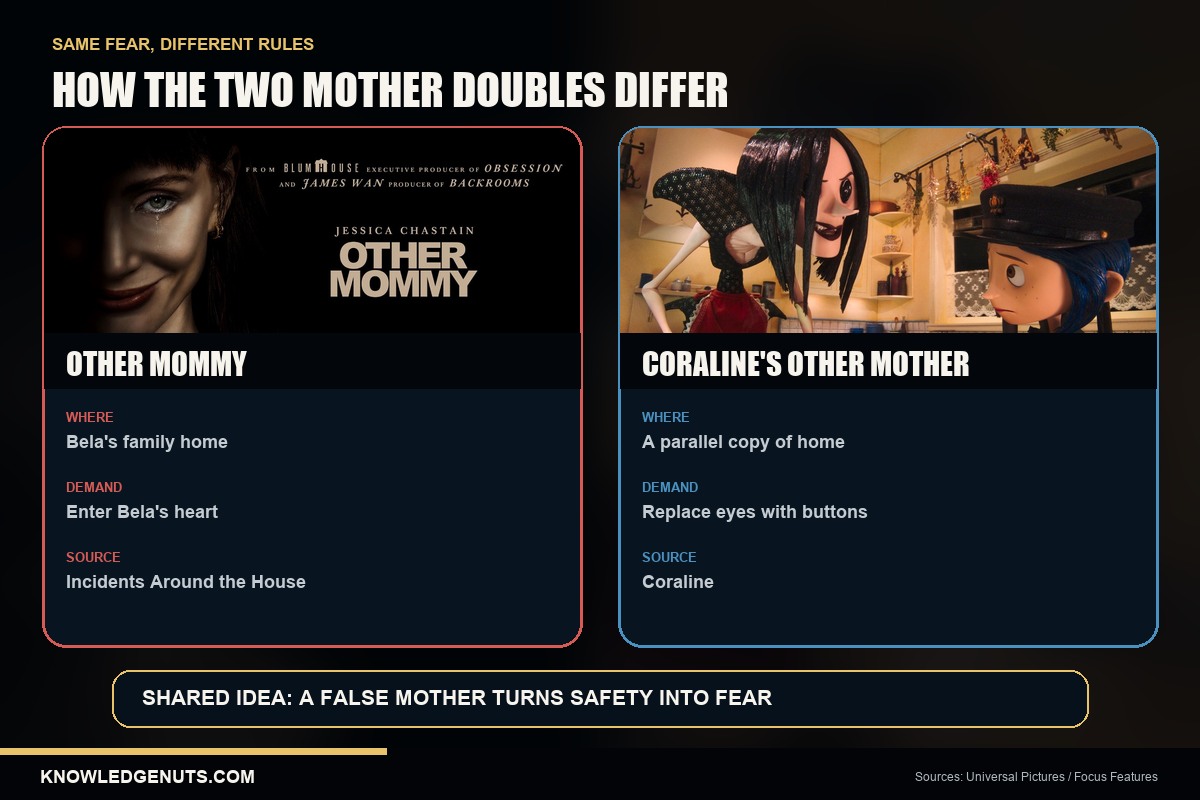
Both stories make the familiar parent frightening by changing one basic question: what if a child met a second mother who offered attention or intimacy but wanted control in return?
| Question | Other Mommy | Coraline |
|---|---|---|
| Where does the threat appear? | Inside Bela’s family home | In a parallel copy of Coraline’s home |
| What does the child call it? | Other Mommy | Other Mother |
| What makes it familiar? | It looks like Bela’s mother | It resembles Coraline’s mother |
| What is its signature demand? | It asks to enter Bela’s heart | It asks Coraline to replace her eyes with buttons |
| What is the source? | Incidents Around the House by Josh Malerman | Coraline by Neil Gaiman |
The overlap is strongest at the level of childhood fear. In both stories, the mother is supposed to represent safety. A convincing copy reverses that protection: the face that should settle the question becomes the reason the child cannot trust what she sees.
Is Other Mommy copying Coraline?
The available evidence supports comparison, not a claim of copying. In Coraline, another mother and father want Coraline to stay in their world. Malerman’s novel gives Bela a different entity, a different request and a story rooted in her own family’s damaged home.
Calling the new film “like Coraline” is useful shorthand for the unsettling mother double. It becomes misleading if it suggests shared characters, button eyes or a secret continuation. Coraline builds an enticing replacement world that a child must refuse. Other Mommy brings the false parent into the world the child already has. That difference is where the new film has room to become its own story.
