

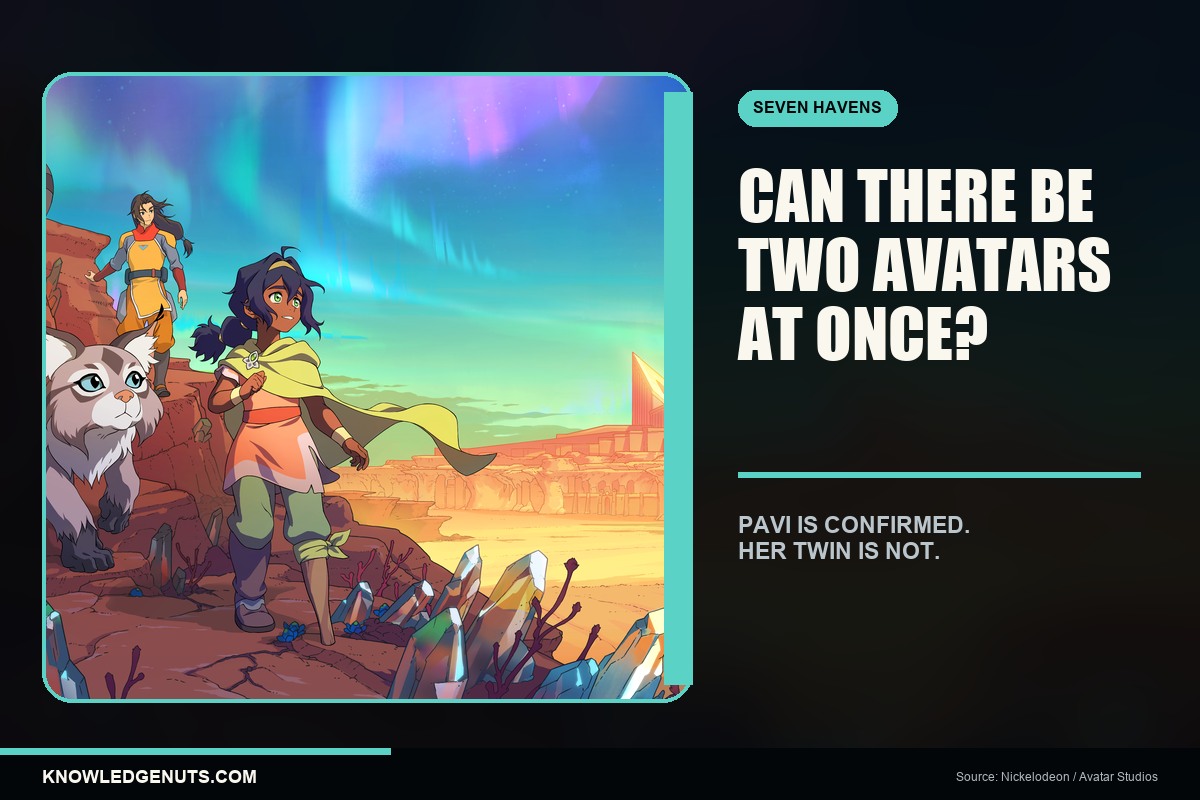
No, not under the ordinary Avatar Cycle. The Avatar is one reincarnating spiritual line, so a new Avatar succeeds the previous life rather than existing beside it as an equal second incarnation. Avatar: Seven Havens identifies Pavi as the new Earthbender Avatar after Korra, while Nisha is identified as Pavi’s long-lost twin. It has not confirmed that both sisters are Avatars.
That answer leaves room for the show to surprise viewers. The franchise has already created one unusual period in which Korra and a “Dark Avatar” existed at the same time. That event did not split the normal Avatar into two people, however, and a twin relationship by itself does not recreate it.
What Seven Havens Has Actually Confirmed
Pavi is a young Earthbender who becomes the new Avatar after Korra. In the fractured world around her, people see the Avatar as humanity’s destroyer rather than its savior. She and her long-lost twin must uncover their origins and save civilization’s remaining strongholds.
The wording draws a clear line between the sisters. One is “the new Avatar.” The other is “her long-lost twin.” The confirmed premise contains one new Avatar, not a pair, a divided Avatar spirit or two successors to Korra.
The teaser released at San Diego Comic-Con on July 23, 2026, supplies the sisters’ names. Pavi is voiced by Saheli Khan and Nisha by Aishu Devan, and the series is scheduled to premiere on October 9. Images of twins, mirrored characters and opposing spiritual forces naturally invite theories. They are clues to discuss, not confirmation of a new rule.
Why the Normal Cycle Produces One Avatar
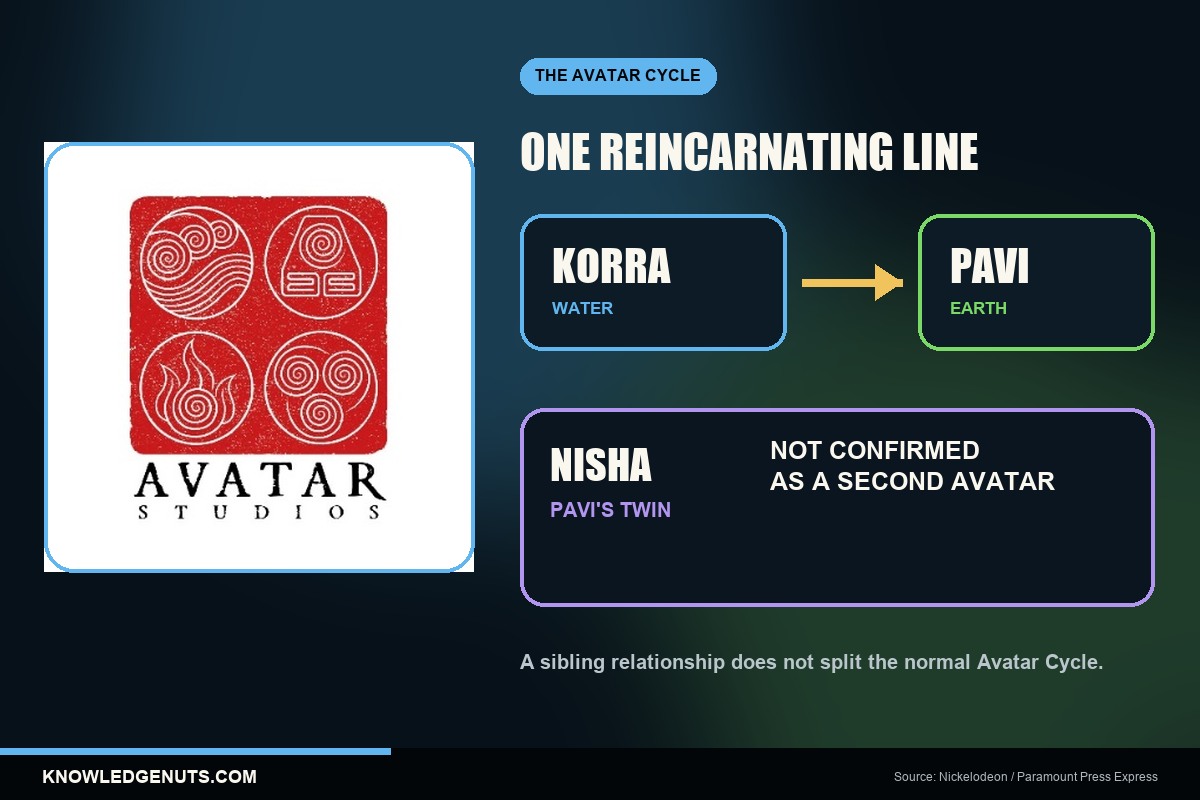
The Avatar is not a position filled by a new applicant whenever the world needs help. Aang was the reincarnated Avatar, carrying the same role that belonged to earlier lives while being a distinct person with his own upbringing and choices. Korra followed Aang in that line, and Pavi follows Korra.
The elemental pattern reinforces the sequence. The franchise’s official timeline begins with Wan as the first Avatar and records more than 90 later Avatars before the better-known eras. It also gives the cycle as water, earth, fire and air. Starting from the familiar run of Kyoshi, Roku, Aang and Korra, the order is Earth, Fire, Air and Water. An Earthbender after Korra is exactly where the cycle points next.
Reincarnation is therefore different from duplication. A successor continues the Avatar line after the previous incarnation. A sibling can share parents, age and appearance with the Avatar without automatically sharing that spiritual identity. If Seven Havens changes this rule, the change needs an explanation inside the story.
This also explains why “both twins can bend” would not settle the question. Bending one element is common throughout the four nations. The Avatar’s defining ability is the connection that allows mastery of all four, along with the spiritual continuity behind the Avatar State. Nisha being an Earthbender would make her Pavi’s twin and fellow bender, not necessarily a second Avatar.
The Dark Avatar Was a Different Kind of Exception
The Legend of Korra did briefly place two Avatar-like figures in the same conflict. In Book Two’s “Darkness Falls”, Unalaq merges with Vaatu, the spirit of darkness and chaos, during Harmonic Convergence. He becomes the Dark Avatar while Korra remains joined to Raava.
That is the closest established precedent for two Avatars existing simultaneously, but its mechanism is specific. Unalaq was not Korra’s reincarnation, and Raava did not divide between them. Vaatu formed a separate bond with another human, copying the basic spirit-and-human arrangement that had produced the first Avatar.
The overlap was also short. The conflict disrupted Korra’s link to her past lives, and Unalaq did not establish a lasting parallel line of Dark Avatars. The story treated his transformation as an extraordinary challenge to the existing order, not as proof that the normal cycle had always allowed two successors.
That history gives Seven Havens several possibilities without confirming any of them. Nisha could be tied to a spirit, used as a decoy, mistaken for Pavi or involved in a different mystery. She could also remain a non-Avatar whose importance comes from being the one person most closely connected to Pavi. Calling her a Dark Avatar now would replace an unanswered question with fan speculation.
What Would Confirm a Second Avatar
Matching costumes, mirrored imagery or a mysterious glow would not be enough on their own. A genuine second Avatar would require the story to establish a second spiritual bond, a divided connection to Raava or another mechanism that grants Avatar status while Pavi is still the Avatar. An explicit statement from the series or its creators would settle it more reliably than a trailer frame.
The same caution applies if Nisha displays an unusual power. The broken world of Seven Havens may contain new bending conditions, spirits and technology. An unexplained feat can begin the mystery without answering it.
For now, the precise description: Pavi is Korra’s successor and the new Avatar, and Nisha is Pavi’s long-lost twin. The Avatar world has made room for a separate Dark Avatar before, so two Avatar-like figures are possible under exceptional circumstances. Seven Havens has not yet established that its twins are such a pair.
