

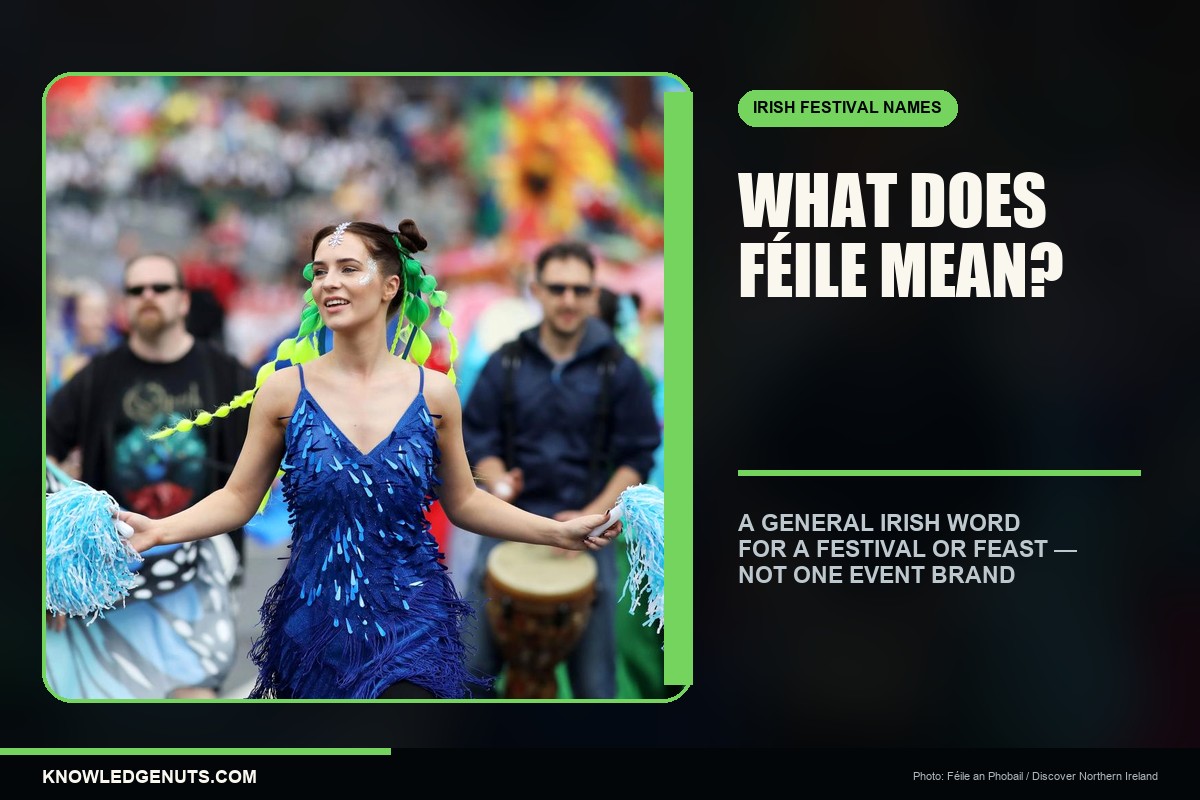
Féile is an Irish noun meaning a festival, feast day or public celebration. That is why it appears in so many Irish event names: it identifies the gathering, while the words that follow can identify a community, season or subject. Féile an Phobail, for example, is the name of a specific community festival in West Belfast.
Féile an Phobail’s first 2026 programme events take place on July 24, including a 24-hour Raidió Fáilte broadcast and a walking tour. Later entries include concerts, Irish-language activities, debates, sport and family events. The current programme shows how one Irish word can function both as a common noun and as part of a proper event name.
Féile is an ordinary word, not one festival brand
The core meaning is broader than any single event. Féile can refer to an organised festival, a religious feast day or another public celebration. It is a feminine noun with the plural féilte. The word also has a documented sense of generosity or hospitality, but a concert or community programme will normally make the festival sense obvious.
The dictionary word and the event name should not be confused. Lowercase féile is the ordinary noun found in Irish dictionaries. Féile an Phobail is a specific organisation and festival, but another event can use the same noun without belonging to that organisation.
Féile an Phobail began in 1988 as a community response to conflict in Northern Ireland, celebrating local creativity, arts and sport. It later grew from a one-week event into a year-round programme whose August festival is its flagship. The familiar word féile describes the kind of gathering, while the full name identifies this particular organisation and programme.
The fada and the plural belong to the word
The mark over the first e is called a fada. In Irish spelling, É or é is identified as a long E, so Féile and Feile are not simply two decorative versions of the same spelling. The Irish word is written féile.
An English-looking pronunciation guide can be misleading because Irish pronunciation varies by dialect. The word can be heard in Ulster, Connacht and Munster recordings. Listening to those regional examples is safer than assuming it should sound exactly like an English word suggested by its letters.
The plural is féilte, not “féiles.” Seeing féilte therefore signals that more than one festival or feast day is being discussed. When an event provides an established English name, use that version instead of translating each word in the Irish title from memory.
Festival names tell you more than the word féile
Once the shared festival word is recognised, the remaining words distinguish one event from another. Féile an Phobail names the West Belfast organisation. Féile an Earraigh is another festival run by the same organisation in spring, with a programme centred on Irish and Celtic art, traditional music, culture and language.
This naming pattern is flexible. An event can be named for a place, season, community, saint, art form or subject. Seeing féile in two titles does not mean the events are branches of the same organisation. It usually means only that both titles use the Irish word for festival.
The broad meaning of féile also suits events that mix formats. Féile an Phobail is not just a run of concerts. Its programme can include exhibitions, discussions, walking tours, sport, classes and community activities. “Festival” describes the gathering as a whole rather than one required kind of performance.
Féile and feis overlap, but feis has a competitive history
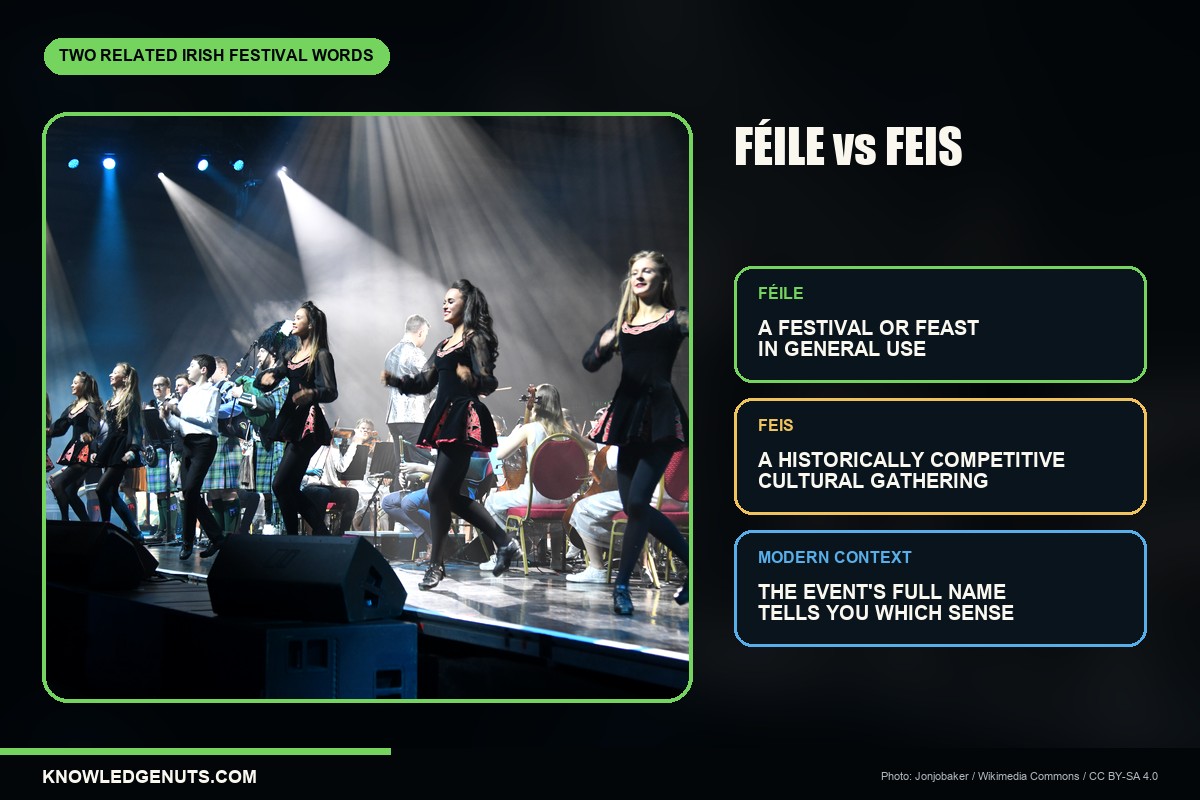
Feis is another Irish word associated with festivals, and the two should not be presented as perfect opposites. Historically, feis could mean a recurring feast or festival. From the 1890s, however, the term became closely associated with annual competitive cultural festivals organised by branches of the Gaelic League.
Those feiseanna featured judged contests in essay writing, poetry, storytelling, singing, dancing and instrumental music. Competitors could receive medals or certificates, and programmes often ended with a prize-winners’ concert. That history explains why modern readers often encounter feis in a competitive music or dance setting.
The practical distinction is one of emphasis, not an iron rule. Féile is the broad, everyday festival word and readily suits a mixed arts or community programme. Feis often signals a traditional event organised around performance and adjudication, although its older meaning is also “festival.”
When an unfamiliar Irish event name begins with Féile, read it first as “festival,” then look to the remaining words for the identity of the celebration. Keep the fada, use féilte when a plural is needed and check the event’s established English name before translating the whole phrase. If the title uses feis, look for competitions, adjudicators or graded performances before assuming it works like a general community festival.
