

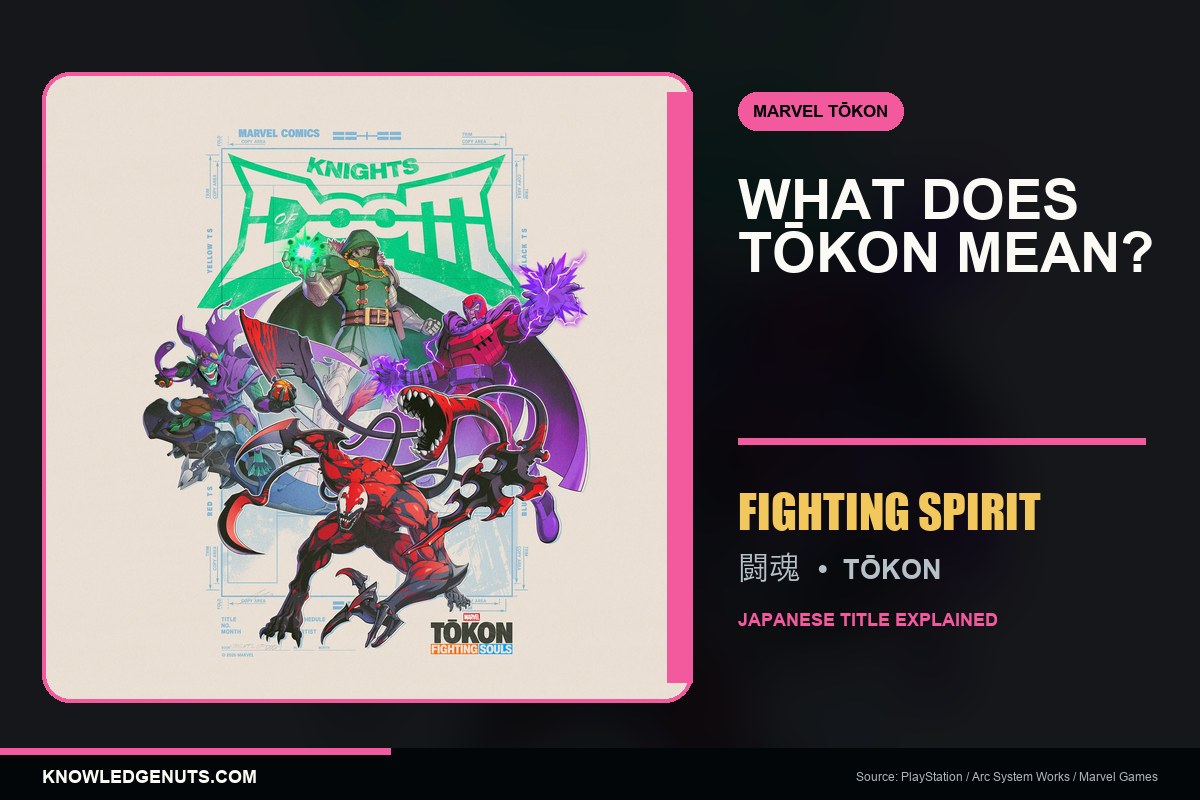
The word Tōkon in MARVEL Tōkon: Fighting Souls is the romanized form of the Japanese word 闘魂 (とうこん). Its natural English translation is “fighting spirit.”
That meaning also explains why the game’s subtitle feels so closely connected to its Japanese name. “Fighting Souls” is not a word-for-word translation, but it echoes the ideas contained in the two kanji: fighting and spirit.
The question is especially timely because a 72-hour open beta began on July 24 on PS5, Steam, and the Epic Games Store. It includes 15 of the 20 characters planned for launch and teaches the fundamentals of the 4v4 system. For many players, that beta may be their first encounter with the word Tōkon.
The official title is MARVEL Tōkon: Fighting Souls. The game is a 4v4 tag fighter from PlayStation Studios, Arc System Works, and Marvel Games. It is scheduled for release on PS5 and PC on August 6, 2026.
What Does Tōkon Mean in Japanese?
闘魂 is read とうこん and means “fighting spirit”. It names the spirit someone brings to a fight rather than a literal soul battling another soul.
The expression can be understood by looking at its two kanji:
- 闘 (tō) means fight or war.
- 魂 (kon) means soul or spirit.
Put together, the characters create the image of a soul ready for battle. English normally renders the complete expression as “fighting spirit,” which sounds more natural than replacing each kanji mechanically.
The Japanese spelling is 闘魂, while its hiragana reading is とうこん. The same “fighting spirit” translation appears in Kotobank’s Japanese-English dictionary.
Reading the characters separately helps explain the image behind the term, but the whole expression points to the spirit carried into a fight as much as to the fight itself.
Why Is There a Line Over the O in Tōkon?
The horizontal line over the ō is called a macron. In Japanese romanization, it marks a long vowel. In other words, the first o sound in Tōkon is held longer than an ordinary short o.
The macron is not an English-style stress mark, and it does not tell readers to say that syllable more loudly. It represents vowel length. Long Japanese vowels are written with macrons in the romanization system used here.
That gives us:
- とうこん in hiragana
- 闘魂 in kanji
- tōkon in romanized Japanese
The title’s typography therefore preserves useful information about the Japanese pronunciation. Writing it as Tokon may be easier on keyboards that lack accented characters, but it drops the visible marker for the long o.
Readers do not need to treat ō as a different letter with an unfamiliar English sound. The important point is duration: the bar signals that the vowel is long. It belongs to the romanized spelling because the original hiragana, とうこん, already contains the information represented by that macron.
How Does Tōkon Relate to “Fighting Souls”?
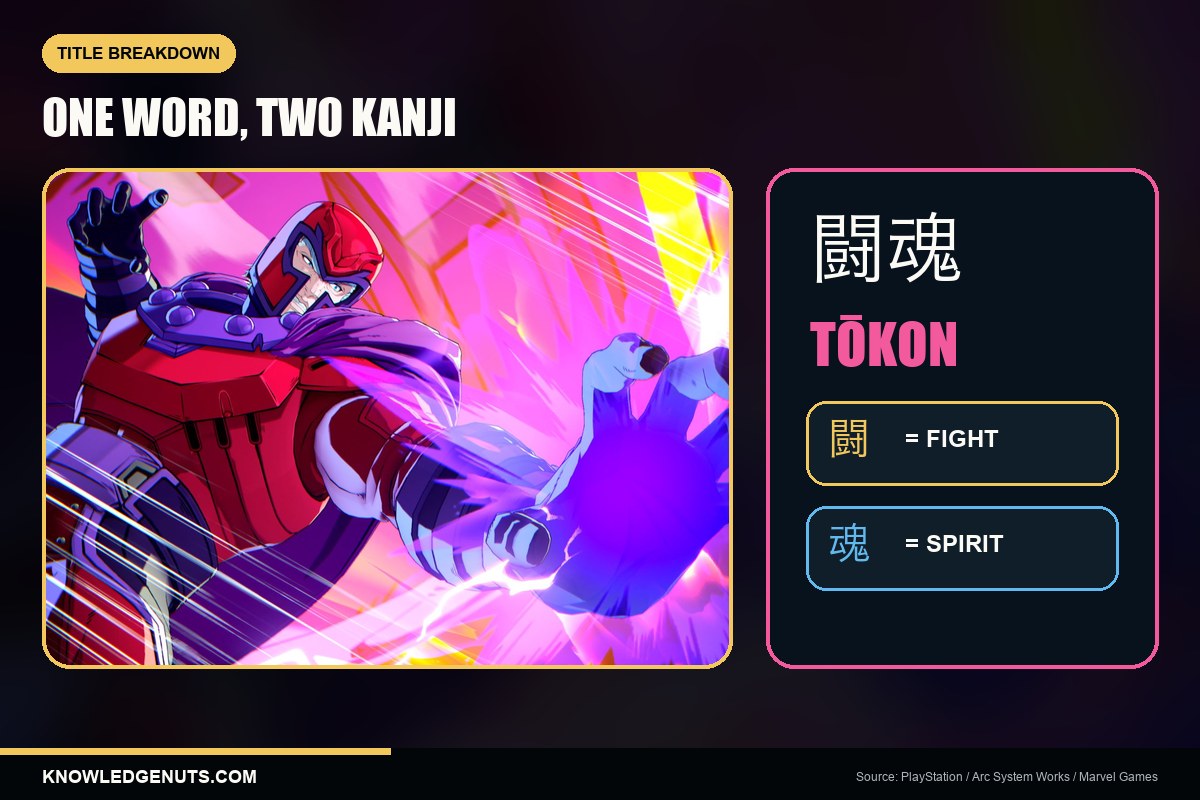
The subtitle “Fighting Souls” closely mirrors the two ideas inside 闘魂:
- 闘 supplies the fighting element.
- 魂 supplies the soul or spirit element.
Still, “Fighting Souls” and “fighting spirit” are not interchangeable translations. “Fighting spirit” is the natural dictionary meaning of the complete Japanese expression. “Fighting Souls” works as an English subtitle that preserves the imagery of the individual characters while sounding like the name of a fighting game.
This is a strong linguistic connection, but it is not a confirmed account of how the developers chose the title. The supported conclusion is that the Japanese word and English subtitle share the same fight-and-spirit imagery.
Why the Name Fits a Marvel Fighting Game
As a title, Tōkon naturally suits a game built around combat, determination, and teams of Marvel characters. The word’s emphasis on fighting spirit also gives it more emotional force than a simple label such as “battle” or “fight.”
It may be tempting to connect “Fighting Souls” directly to the game’s four-character teams or shared team play. That is a reasonable interpretation of how the title feels alongside the game’s design, but it is not an official naming explanation.
What can be said directly is that tōkon means fighting spirit, while the subtitle reshapes the same fight-and-spirit image into an English game title.
The Meaning in a Nutshell
Tōkon (闘魂) means “fighting spirit.” The first kanji, 闘, carries the idea of fighting, while 魂 means soul or spirit. The macron over ō marks a long Japanese vowel. It does not mark English stress.
“Fighting Souls” draws on the same imagery, but “fighting spirit” is the natural translation of the Japanese word as a whole. The full title places that Japanese expression beside an English phrase built from the same fight-and-spirit image.
