

In A Nutshell
While on an expedition into Africa during the late 19th century, James Jameson, heir to the Jameson Irish whiskey empire, reportedly asked to witness cannibalism in action. To this end, he purchased a slave girl and handed her over to men who murdered her and feasted on her flesh. While the grisly scene unfolded, Jameson is said to have sketched it out, later turning his rough illustrations into a series of watercolors. The story rests on a translator’s sworn affidavit that was later contested, and Jameson died before he could fully answer the charge, so historians still treat the account as disputed.
The Whole Bushel
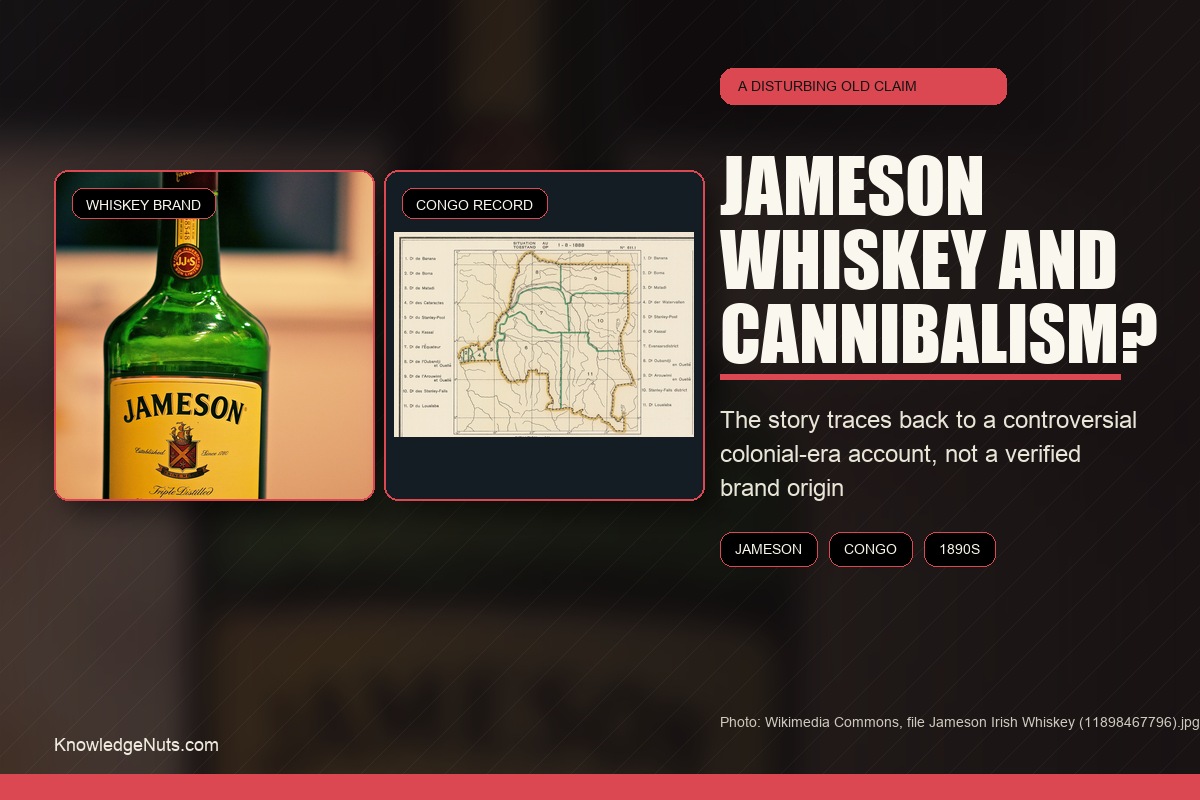
Jameson is far and away the best selling Irish whiskey in the world, trumping other such brands as Bushmills and Tullamore Dew. The Scottish lawyer John Jameson founded the company in 1780 in Dublin, Ireland. Jameson whiskeys have been very highly regarded over the years, but there is a horrifying legacy at the bottom of the bottle.
The end of the 19th century was a time of unimaginable cruelty in Africa as the nations of Europe sought to divide it into imperialist states. Millions of Africans were killed by the conquering forces from the north as white men pillaged the land for its vast natural resources, gold, and diamonds. Expeditions were sent to the heart of the “dark continent” hoping to uncover treasures.
One such excursion featured the wealthy James Jameson, heir to the whiskey empire. According to an affidavit by Assad Farran, a Syrian translator on the Emin Pasha Relief Expedition into the Congo, Jameson expressed an interest in witnessing cannibalism in 1888. He was advised to purchase a slave girl, which he picked up for the bargain price of six handkerchiefs. Jameson gave the 10-year-old girl as a gift to cannibals. She was lashed to a tree and stabbed to death, then hacked apart and devoured. Meanwhile, Jameson stood by, making a series of rough sketches of the incident.
Later, he would render a series of illustrations and display them to others in the group. In describing them, Farran said “There were six of them, all neatly done. The first sketch was of the girl as she was led to the tree. The second showed her stabbed, with the blood gushing from the wounds. The third showed her dissected. The fourth, fifth, and sixth showed men carrying off various parts of her body.”
Jameson died of fever months later, on August 17, 1888, before he could fully defend himself. In his own diary he admitted he was present and that he handed over the handkerchiefs, but he insisted he thought it was a bluff and never believed the men would really kill anyone until it was too late. The charge only became public in 1890, when the expedition’s leader, Henry Morton Stanley, printed Farran’s affidavit in The Times as the conduct of the rear column came under heavy criticism. Farran later backed away from parts of his sworn account, and in 1891 Jameson’s widow, Ethel, published his diaries to defend his name. More than a century on, the story is still contested. Snopes rates it a “mixture”: by his own admission Jameson witnessed the girl’s murder and paid the handkerchiefs, but whether he set out to buy a child and watch her die remains disputed.
