


In A Nutshell
Queen Victoria is one of the longest-reigning monarchs of the British Empire, and one that has always been a figurehead for British royalty. Surprisingly, her popularity got a boost each time someone tried to kill her—and that happened at least seven times during her reign. The first came a few years into her reign, and others include attempts by a hunchbacked teenager and a man who hated the number four as much as he hated the Queen.
The Whole Bushel
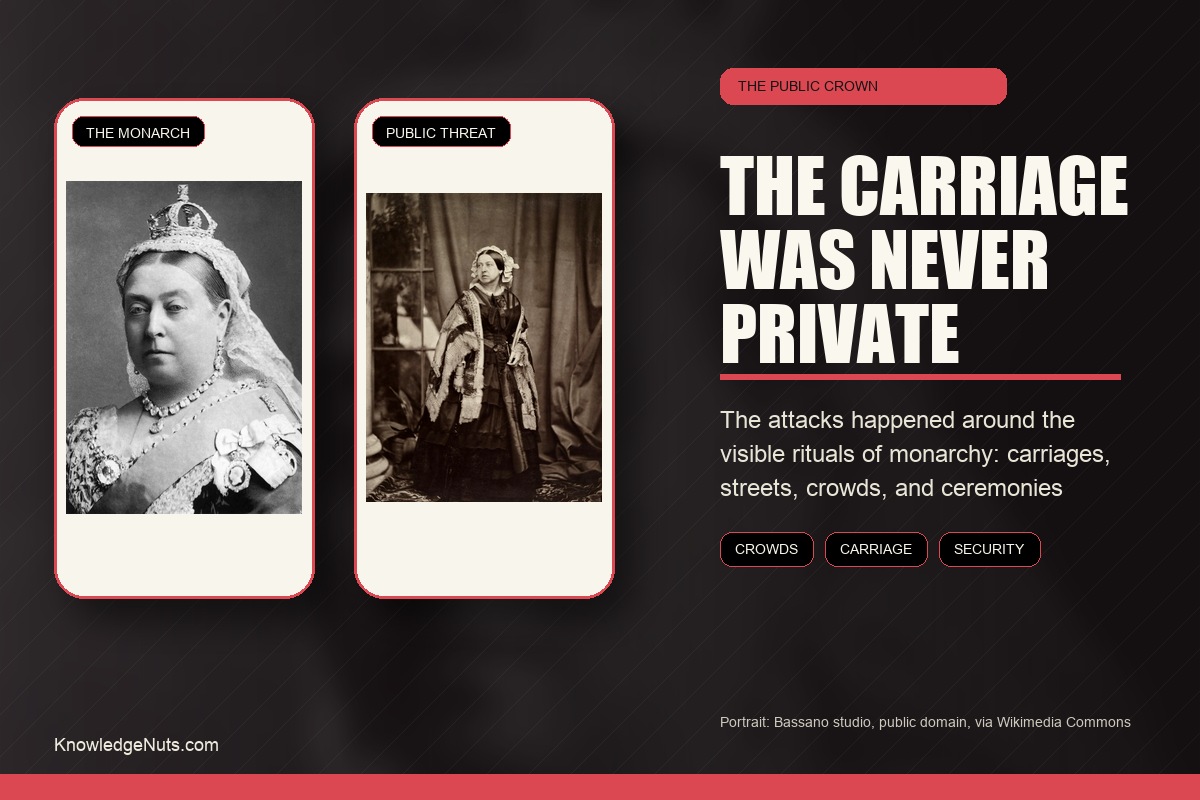
Queen Victoria was born in 1819, and took the British throne in 1837, after the passing of her uncle, William IV. Between her ascension and her death in 1901, she had given her name to an era of British history, expanded the British empire and extolled the virtues of its imperialistic nature, and was—for better or worse—a devoted and loving wife to a man who was never truly accepted by his adopted English country.
Less well known than her political and personal successes are the numerous assassination attempts that were made on her life during her reign and her refusal to give her would-be assassins any satisfaction whatsoever. The assassination attempts led to not only changes in English law but huge boosts in the Queen’s popularity as she faced death with a bravery that the people saw as unrivaled.
The first attempts on her life came a few years after she took the throne. In 1840, Edward Oxford, a waiter, fired several shots at both Prince Albert and a four-months-pregnant queen as they rode out in an open carriage. He ended up in an insane asylum, and was released in 1867 on the condition that he leave the country.
In 1842, a man named John Francis fired at the young royal as she was returning from church. The shooter escaped, but returned the next day to give it another try. Using the Queen herself as bait (at her insistence), the police lured out the would-be assassin and arrested him when he tried to kill her again. He was sentenced to death for his attempt, but was eventually deported to a penal colony off the coast of Australia. Because Francis came back two days running, some historians count eight attempts on the Queen rather than seven.
Five weeks later, the Queen was attacked again while riding in an open carriage. This time, the would-be assassin was John William Bean, a hunchbacked teenager armed with a pistol that had been badly loaded with paper and broken pipes. It misfired, and although he initially escaped, he was captured when police simply began rounding up the city’s hunchbacked men. He received only an 18-month prison sentence.
Seven years later, an unemployed Irish laborer named William Hamilton made the next attempt, but his improperly loaded pistol misfired. And in 1850, a man named Robert Pate got close enough to the Queen to hit her. A retired army man, Pate hit the Queen with his walking stick when she was walking home after visiting an ill relative. No stranger to assault and assassination attempts by this point, the Queen’s remarks included a sadness that a man would think it acceptable to strike a woman, and that at least those who tried to shoot her showed more courage. That night, the bruised Queen went out to the opera.
By the 1870s, there were numerous reports that assassination attempts were being planned by Irish groups who were trying to make a point about the treatment they were receiving from the English. The next assassination attempt came in 1872 from an Irishman named Arthur O’Connor, who waved a non-functional pistol and a document he wanted her to sign to release Irish political prisoners. He, too, was ultimately deported to Australia.
The final attack on her life came in 1882, when Roderick Maclean shot at her again as she was traveling in a carriage. Maclean hated the Queen, feared the number four, and believed blue things held supernatural powers. It was this final attempt that prompted a change to the law books, the Trial of Lunatics Act of 1883, enabling a person to be found guilty but insane.
So common were assassination attempts on the Queen’s life that, at one point, it was thought the attempts were all about glory. In order to neutralize the imagined glory the attackers would gain from being labeled as traitors, the crime was briefly demoted to a simple misdemeanor, with the guilty party getting only a short jail sentence and a whipping.
Show Me The Proof
Queen Victoria: A Biographical Companion, by Helen Rappaport
BBC History: Victoria (1819–1901)
Express: The men who tried to kill Queen Victoria
Painting: Alexander Melville
