

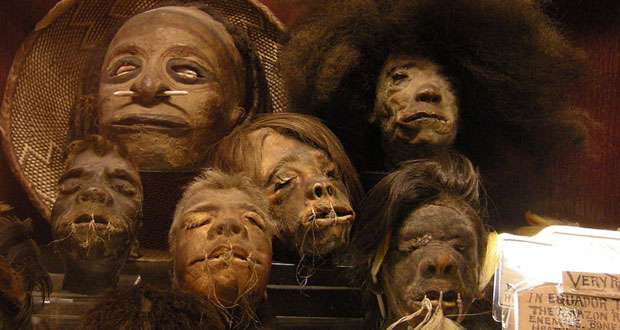
Although there were numerous headhunting tribes rumored to practice head-shrinking across the globe, only a few of these tribes were actually documented doing so. Among a few indigenous tribes in South America, mainly in Ecuador and Peru, the most well-documented tribe was the Jivaroan people, who would take a head from an enemy, shrink it into a tsantsa, and use it as a way to paralyze their enemy’s spirit. In doing so, not only was the head used as a battle trophy but it signaled that the foe’s strength was passed onto the killer, and it prevented their foe from taking revenge. It is the Shuar, a sub-tribe or dialect group of the Jivaroan people, that have received the most notoriety through their customary practice of head-shrinking. According to the head-shrinking ritual that was recorded by European explorers during the 19th century, there are approximately three steps and they went a little like the following.
Step One: Deflesh the Head
After attacking an enemy, killing them, and decapitating them, the tribe would move a safe distance away from the battlefield and set up camp. The first step in the process required the warrior to remove the scalp, which was done by making an incision across the back of the neck and up the back of the head, parallel to the ears. This incision would allow the warrior to tug the skin up towards the top of the head and then again towards the face. The warrior would then use a sharpened piece of wood or a knife to work the skin and flesh away from the facial features as well as the cartilage away from the ears and nose. Finally, the eyes are sewn shut and the lips are skewered with wooden pegs, which are replaced with dangling strings later on in the process.


Step Two: Simmer It
With the flesh completely removed from the skull, the tsantsa goes into a boiling pot or cooking jar of water. The head (no skull present) is left to simmer in the boiling water for an hour or two but no longer than this as that would cause the hair to fall out. When removed, the head is a bit smaller than what it was originally, about 1/3 of the original size, due to the skin shrinking up from the extreme heat. The head is then turned inside out, stripped of any muscle, fat, or remaining cartilage, and the incision that was made on the back of the neck is sewn closed.
Step Three: Apply Sands and Stones
In the third and final step, the head is shrunk even further by placing hot sands and stones into the hole where the neck used to attach to the spine. As the head shrinks down further and can no longer accommodate any more stones, sand is poured into the hold and shaken so that it gets into the crevices that the stones could not reach. Once the head has been shrunk down to the right size, or as far as it can go, hot stones are used to sear the exterior of the skin to shape the facial features. During this entire process, the head is continuously rotated over a hot flame in order to avoid scorching of the skin. If there is any excess hair, it is singed off and the lips are dried with a heated machete. The final product is left over the fire to harden up and blacken. Once complete, three chonta are put through the lips and are lashed together with dangling string.
All in all, the entire process takes about a week to complete and is worked on a daily basis, as the tribe makes their way back to their village. During the celebration that takes place soon hereafter, a hole is made in the top of the head and a double kumai is inserted and tied to a shirt stick. This is what allows the warriors to wear the shrunken heads around their necks. The Jivaroan tribe were preoccupied with making their tsantsa realistic, and so careful preparation and care was taken to ensure that the original likeness of the victim was preserved.


