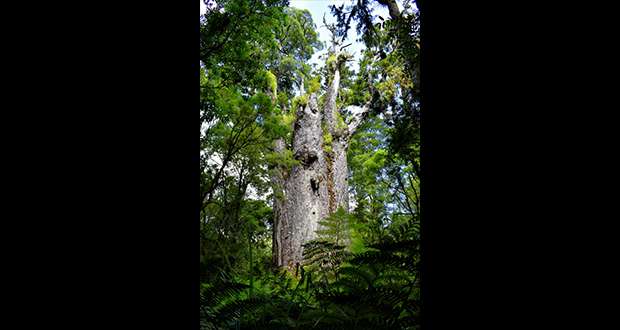
You may think vampires are limited to the tales of undead humans drinking blood, but you might be surprised to learn about one peculiar so-called vampire tree found in the forests of New Zealand. Without further ado, here’s everything you need to know about New Zealand’s Vampire Tree.
What is New Zealand’s Vampire Tree?
Popularized by a 2019 iScience study, scientists found vampire-like behavior in the stump of a living kauri tree. The tree had extended its roots into an interweaving community of surrounding trees, forming what the study authors called a “superorganism.” The vampire tree grafts its roots onto dozens or even hundreds of other trees, sucking in the water and nutrients at night that the other trees spent all day collecting. How’s that for a vampire?

Without the water and nutrients drained from its neighbors, the kauri tree stump would most certainly be dead. It lacks green tissue of its own, according to study co-author Sebastian Leuzinger. As for why the host trees don’t cut off the leaching stump, Leuzinger and his colleges theorized the vampire tree’s superorganism acts as a network of water and nutrients, taking turns pumping resources to one another.
“This has far-reaching consequences for our perception of trees,” Leuzinger said. “Possibly we are not really dealing with trees as individuals, but with the forest as a superorganism.”
How was New Zealand’s Vampire Tree Discovered?
“My colleague Martin Bader and I stumbled upon this kauri tree stump while we were hiking in West Auckland,” said Leuzinger, who noted, “It was odd, because even though the stump didn’t have any foliage, it was alive.”
Leuzinger and Bader went on to uncover the stump’s vampirish nature by measuring the flow of water in the stump and the surrounding trees of the same species. In effect, they found a strong negative correlation in the water flow between the trees. In other words, though genetically different, they were sharing resources thanks to grafted roots recognizing nearby root tissue.
“This is different from how normal trees operate, where the water flow is driven by the water potential of the atmosphere,” Leuzinger said, “In this case, the stump has to follow what the rest of the trees do, because since it lacks transpiring leaves, it escapes the atmospheric pull.”
Is New Zealand’s Vampire Tree Dangerous?
One potential consequence of the vampire tree’s superorganism is the possible rapid spread of diseases. Although complex root systems enable trees to grow in particularly dry areas of the forest, Leuzinger notes kauri dieback as one such disease which could threaten the entire superorganism.
Kauri dieback is a disease that originates in the soil as a microscopic organism called Phytophthora agathidicida. This fungus-like organism infects kauri roots, targeting the water- and nutrient-carrying tissues before effectively killing the tree through starvation. It’s no wonder why kauri dieback is such a threat to a superorganism connected by grafted kauri roots.
What Does New Zealand’s Vampire Tree Mean for the Future?
Researchers are looking for more types of kauri tree stumps to further study the formation of root systems between stumps and living trees. Should they discover more vampire trees and the scope of the research expands, a better understanding of such resource-sharing superorganisms may be significant to the longevity of forests.
“This is a call for more research in this area, particularly in a changing climate and a risk of more frequent and more severe droughts,” said Leuzinger. “This changes the way we look at the survival of trees and the ecology of forests.”