In A Nutshell
The British and Irish countrysides are home to thousands of massive standing stones. Some are contained in stone circles while some, called menhirs, are single, solitary monuments. Others form ancient burial grounds, like dolmens and court cairns. Passage graves, like Newgrange, are massive burial grounds.
The Whole Bushel


The countrysides of Great Britain and Ireland are defined by their standing stones. Magnificent displays of prehistoric engineering, the stones might at first glance look to be simple monuments. But there are a number of different types of megaliths, each type having breathtaking examples found across the island nations.
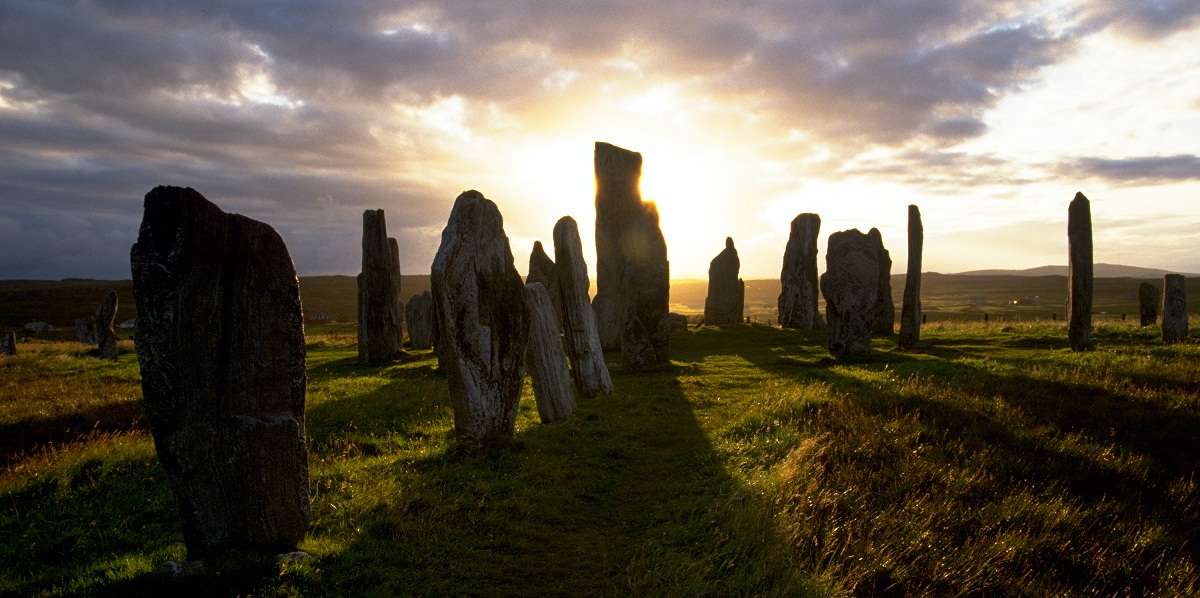
The simplest of these is the menhir, which is a single, massive stone that stands as a lone monument with its base buried in the earth. In some areas, there are hundreds of these single stones clustered around each other. Groups of standing stones are still considered individual menhirs when they have no apparent connection to each other. Some menhirs bear intricate carvings, and it’s not unusual to find standing stones that are created from a type of rock not found from any location in the immediate area. Popular theory is that these stones serve as grave markers.
Megaliths were also created as tombs. One of the sub-groups of chambered tombs, a dolmen is made up of a single, flat stone that rests on the top of between three and seven other standing stones that have been sunk into the ground as a base for this top stone. This top stone is not always still intact. In some, like Ireland’s Browneshill Dolmen, the capstone has fallen off one of the supporting stones. This type of megalithic monument is also called a cromlech, meaning “curved stone.”
Similar to the dolmen is the cove. Coves are a group of tightly clustered standing stones, usually three or four, forming a complete or mostly complete box. Unlike the dolmen, these structures have no roof stone.
The other type of chambered tomb is the passage grave. Passage graves are typically buried in mounds, getting their name from a stone-lined passage leading from the entrance to the mound into a central burial chamber. Unlike other large, impressive tombs (like the pyramids) most passage graves are the final resting place for a large number of individuals rather than just a single person. The oldest passage graves can be found in Brittany, and there are more than 300 across Ireland, with some of the earliest dated to before 4,000 B.C. One of the most well-known examples of this type of megalith is Newgrange, which also features an entrance that is aligned with sunrise on the winter solstice.
Court cairns are massive, long tombs constructed with large boulders and covered with smaller stones. Most of these structures are in the north and northwest of Ireland, and the rarity of them leads to the conclusion that they were the graves of elite or special individuals.
Wedge-shaped tombs are, as their name suggests, tombs that are constructed with a wide mouth and a narrow, wedge-shaped interior chamber. These come relatively later in the time scale of megalithic monuments, with many including artifacts that suggest the presence of early copper-working and metallurgy.
One thing that all the stone megaliths seem to share is their installation of wonder in the Briton peasantry. There are an amazing number of stories of how fairies helped in the original construction of the stones, and even how the stones travel a great distance once every century to the sea in order to perform their ritual ablutions.
Show Me The Proof
Legends and Romances of Brittany: Menhirs and Dolmens
Late Stone Age Megalithic Tombs
Survey of Prehistoric Funerary and Ritual Sites: Long Barrows and Chambered Tombs