In A Nutshell
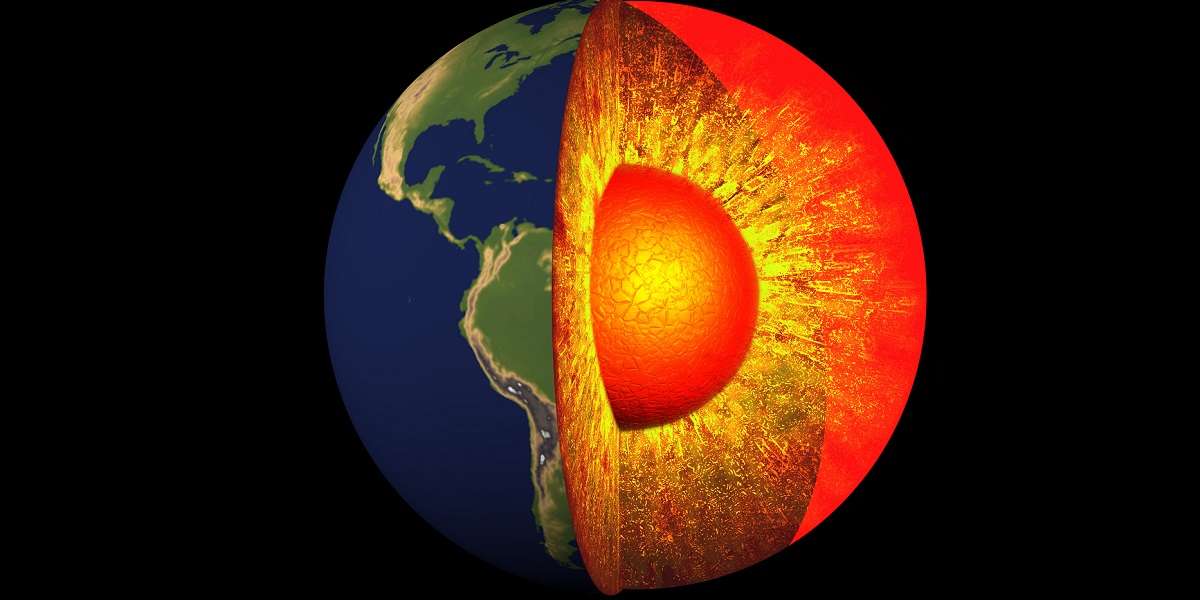
The Earth is composed of a series of layers, and at the very center of it all is a large iron ball we’ve come to know as the inner core. The inner core is responsible for providing the Earth with a magnetic field. If you’ve always imagined that the center of the Earth is full of magma, you’re not entirely wrong—the outer core is molten magma and nickel.
The Whole Bushel


You might imagine that the center of the Earth is full of lava. Or dinosaurs. Or power crystals. Or the Devil. But in reality, the center of the Earth is actually solid iron shaped like a ball (albeit an extremely massive ball).
The technical term for this region is the “inner core,” and the temperature there can reach up to 7,000 degrees Celsius (13,000 °F). If that sort of heat were applied to iron on the surface, it would be a gooey mess in a second. But at the very center of the Earth, there’s far too much pressure for anything to melt. The weight and gravity of the entire planet are keeping the iron solid.
Since no one has ever been to the center of the Earth, how do we know it’s solid? Well, earthquakes. Seismic waves respond differently to different substances, and bend in reaction to the planet’s different layers. From this, it was deduced that the inner core is solid—and that it is what generates our planet’s magnetism (which is important for things like compasses). Additionally, this magnetism plays a role in reducing the amount of harmful radiation that can reach the troposphere.
Now, the outer core is composed of molten iron and nickel. Temperatures at the outer core can reach 5,000 degrees Celsius (9,000 °F). The other layers of the Earth include the mantle (a rocky interior above the core) and the crust (where literally every known living thing in the universe lives).
Recently, geologists at the University of Illinois at Urbana-Champaign have discovered an inner inner core. It’s still solid iron, it’s just composed of a different crystalline structure.
Show Me The Proof
National Geographic: Core
Universe Today: Discovery of the Earth’s Inner, Inner Core