

In A Nutshell
The Olmec, Mayan, Incan, and Aztec civilizations are some of the greatest ancient civilizations in history, and yet we know very little about them compared to other parts of the world. The Olmecs are frequently forgotten entirely, and the rest are often lumped together or confused, but they were all completely distinct. In short, the Olmecs came first, settling in modern-day Mexico. They never built any major cities, but they were widespread and prosperous, and they are usually called the earliest major culture of the region. The Maya settled that same stretch of Mexico and Central America and lasted the longest of the four. Much later came the Aztecs, also in modern-day Mexico, and the Inca, off in the mountains of Peru — a completely separate corner of South America.
The Whole Bushel
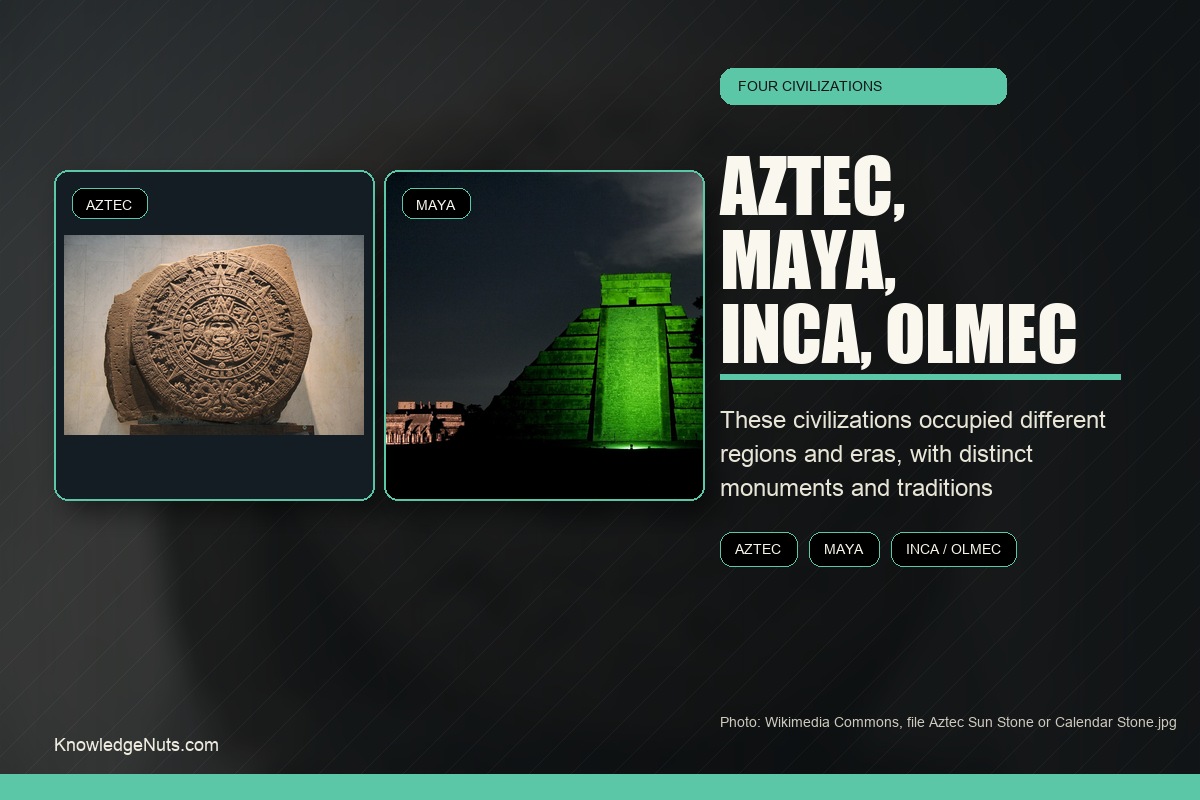
The Maya settled the region early, with village roots reaching back to around 2000 B.C. They lasted the longest of all and are often viewed as the greatest Mesoamerican civilization. They built most of their great cities in the Classic period, between A.D. 250 and A.D. 900. Though the Maya were around from early on, they only really rose to greatness in those later centuries, and many scholars think they borrowed a good deal from the older Olmec culture along the way. The Maya left behind a longer, more prosperous legacy, encompassing parts of Mexico, Guatemala, El Salvador, Belize, and Honduras. They were ruled by kings and priests and were not wiped out like some of the other cultures, but gradually dissipated. Their exact relationship with the Olmecs remains unclear.
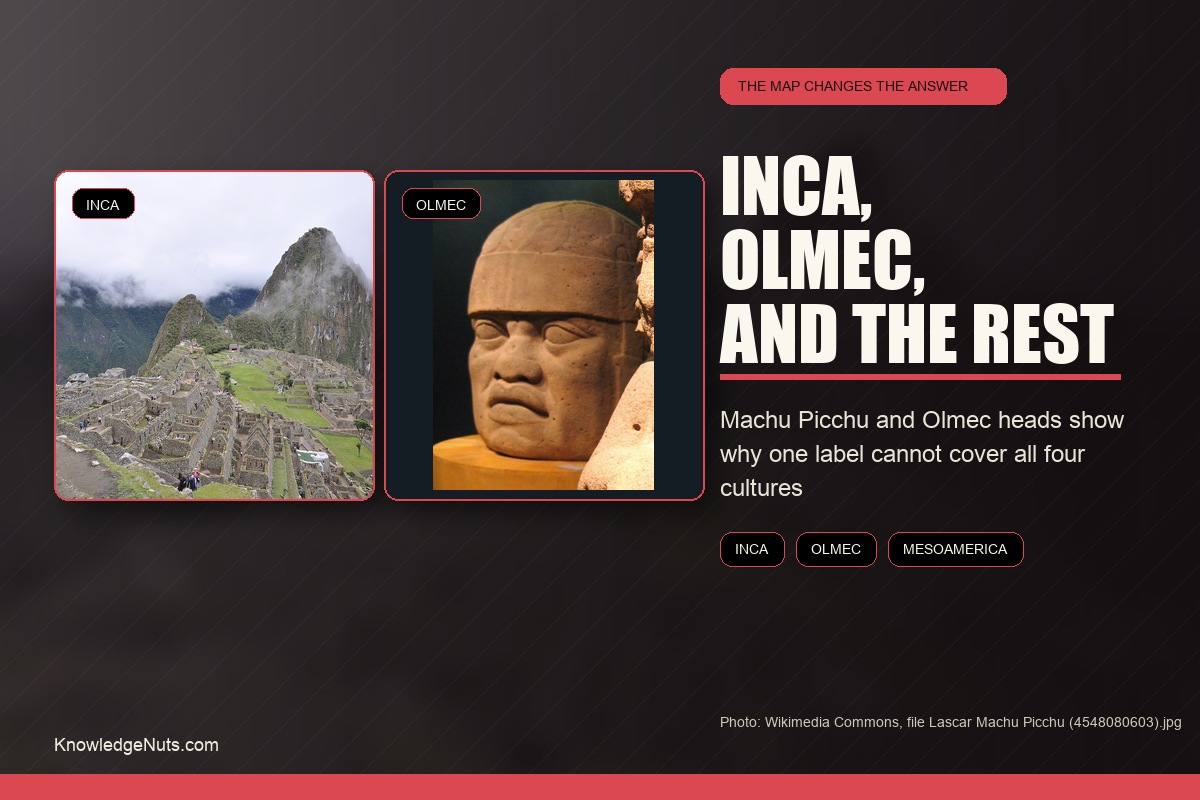
The Olmecs were the first major Mesoamerican culture, older than the rest. The name “Olmec” was almost certainly not what they called themselves but is derived from later Aztec writings. The Olmecs established themselves around 1400 B.C. and lasted about 1,000 years, occupying a reasonably large amount of land. They were good farmers, artists, mathematicians, and astronomers, and they wrote in hieroglyphics, as did most of the cultures that followed them. They never built any major cities that we know of, but they did leave one pyramid behind before they gradually disappeared. Their most famous legacy is the mystery of the Olmec heads: colossal stone portraits up to 3 meters (9 ft) tall, now thought to depict Olmec rulers, carved from basalt that was hauled from quarries over 130 kilometers (80 mi) away. An old idea that the faces looked African was long ago set aside; the features match people still living on Mexico’s Gulf coast today.
The Inca civilization can be traced back to about A.D. 1200. They lived in the mountains of Peru, far removed from the Olmecs, Maya, and Aztecs, and at the peak of their power the empire stretched some 4,000 kilometers (2,500 mi) and held an estimated 10 million or more people. They were extremely advanced and had an army, laws, roads, bridges, tunnels, and a complicated irrigation system far ahead of its time. However, they never invented a system of writing, instead using knotted ropes for record-keeping. A civil war over the rightful heir to the throne meant that when the Spanish invaded, the Inca were easily defeated. The empire fell in 1533.
The Aztecs founded their biggest city, Tenochtitlan, in A.D. 1325, meaning they were much younger than any of the other three. Tenochtitlan was built on an island in a Mexican lake called Lake Texcoco. They gradually conquered the rest of the area, until they fell in 1521 at the hands of Spanish invaders. Although they were not as advanced as the Inca, they did have a 365-day calendar and used hieroglyphics.
Though the cultures are alike in many ways, such as their building of pyramids and use of hieroglyphics (bar the Inca), they are four distinct cultures that rose and fell at different times for different reasons. To quickly sum up, the Olmecs came first, and the Maya, whose own roots run nearly as deep, went on to borrow a lot from them. The Aztecs followed centuries later, rising about 400 years after the Maya’s great cities began to empty. The Inca were from a completely different area and lasted only a few centuries before being wiped out, while still managing to become the most advanced in their short life.
Show Me The Proof
Maya and Aztec
Olmec Civilization
Three Great Civilizations
Mayan History
