In A Nutshell
Bone china, fine china, porcelain: They can look very similar, but there’s a definite difference in what they’re made from. Bone china is, as its name suggests, made from bone—cow bone in particular, although in rare cases you could be eating off of a plate made from a dead person. The same manufacturing processes are used in making fine china, but without the bone content. Porcelain is also created in much the same way, but it’s fired at a higher temperature and the end result is much harder.
The Whole Bushel


Bone china is, as its name suggests, made from cow bone. The bone is finely ground into bone ash, and it is then mixed with feldspar, ball clay, quartz, and kaolin (a type of clay). The quality of the finished product is based on how much bone is in the mixture; a high-quality bone china should contain at least 30 percent bone and can go as high as 40–45 percent.
Porcelain has been around since around A.D. 620; more modern methods and mixtures started to be used around A.D. 1279. Originating in China, the earliest porcelains used kaolin (a type of clay) and pegmatite (a type of granite). Early European versions used clay and ground glass. In 1707, German manufacturers started using feldspar instead of glass in a process that continues today. In today’s porcelain, silica is also added to the raw ingredients. The raw materials are finely ground, cleaned, formed in a mold, and then fired.
The firing process is what creates either porcelain or fine china. If the temperature is high—around 1,455° Celsius (2,650° F)—the finished product is much more durable and is known as porcelain. If it’s fired at a lower temperature—around 1,200° (2,200° F)—it’s known as fine china. Fine china is much softer than porcelain, making it much more suitable for applications such as plates and cups. Porcelain is strong enough and durable enough that it’s suitable for a wide range of industrial applications such as electrical insulators.
Bone china undergoes two firing processes. The first causes the product to shrink, and about 20% of the pieces that are made will crack and break at this stage. The second firing happens after the piece is glazed, and melts the glaze into the piece. Those that don’t crack or break during this stage are then decorated with their final patterns. Many pieces are hand painted or sprayed, though in some cases decals can also be applied.
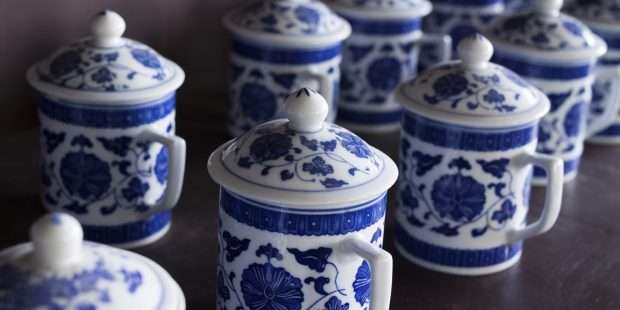
At a glance, it’s easy to tell the difference between bone china and fine china if you know what you’re looking for. The addition of bone ash gives bone china a warm color, while fine china will be a brighter white. If you hold the china up to the light, you’ll see that bone china has a translucent quality compared to fine china. Porcelain is a much more durable material, and is much harder than either type of china.
But then there’s the creepier side of china. American artist Charles Krafft has found that it doesn’t have to be cow bone that’s used for the bone component in bone china. The current mixture used for British bone china was created by a man named Josiah Spode (Spode is still a major manufacturer of bone china in the UK), and Krafft decided to simply swap out the cow bone ash in Spode’s recipe for human bone ash, retrieved from a crematorium and finely milled. Calling his new product “SPONE,” you can still commission him to create a special memento made of your loved ones.
Show Me The Proof
Narumi Corporation: How Bone China is Produced?
How Products Are Made: Porcelain
Noritake: Bone China vs Fine China
Charles Krafft: About