In A Nutshell
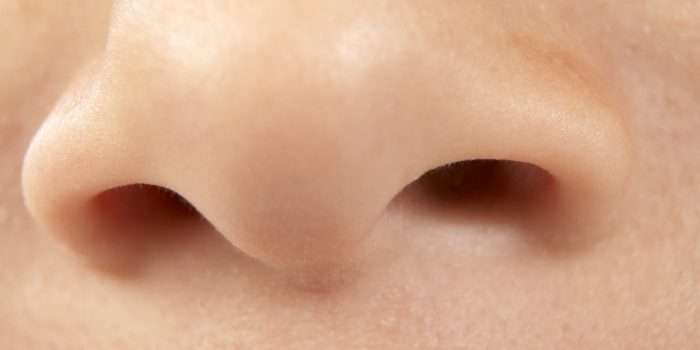
Humans actually have four nostrils—the two nostrils that we’re familiar with on the exterior and two internal nostrils, called “choanae.” Without our external and internal nostrils functioning together, we would not be able to breathe through our noses.
The Whole Bushel


Yes, humans have four nostrils. So do many reptiles and mammals. But the history behind how we came to acquire them is a long one. Early fish (and many modern ones) have all four nostrils on the outside and for decades the question of how humans came to have two internal and two external nostrils was a mystery, until a fossil was discovered that seemed to answer the riddle.
Kenichthys campbelli is a fish fossil that seems to show the nasal passage evolution at a midway point, with two nostrils in between the front teeth. This supports the theory that while the two nostrils we are familiar with stayed on the outside, the other set slowly moved through the teeth and palette to become what are now called “choanae.”
Some previously believed that the choanae did not evolve and move through the teeth, but theorized perhaps that they developed separately to the four external nostrils. However, no animals or fossils have been discovered showing four external nostrils and two internal ones, so this idea remains a theory.
So what do these choanae do? Most importantly they play a big role in our ability to breathe through our noses. Even when our exterior nostrils seem to be functioning, damage or defects to choanae can prevent nose-breathing all together. Newborns tend to instinctively prefer breathing through their noses instead of their mouths. But those with blocked nasal passages, or choanal atresia, will begin to choke when they nurse and will only be able to breathe properly when their mouth becomes clear. Fish only use their nostrils for olfactory reasons, meaning they can smell through them but cannot use them to breathe. Many scientists believe that nasal passages originally evolved in sea creatures to allow them to take in more oxygen without having to constantly surface, a skill that eventually helped them evolve into what we are today.
Show Me The Proof
Fish with cleft lip solves evolution riddle
What Are Choanae?
Sino-Swedish research smells out the truth about the human nose